

7 Best Tankless Water Heaters for Families in 2026
Last Updated: October 25, 2026
Quick Summary
The best tankless water heaters for families are matched to your busiest hour, not your average day. Size for simultaneous fixtures, account for cold incoming water, and confirm your gas line or electrical service can support the model before you buy. Our top pick for large households is the Rinnai RU199iN.
- Size to your busiest 15 minutes, not your daily average hot-water use.
- A family of four can draw roughly 7.5 GPM in a busy morning.
- Northern households should favor condensing gas models with higher BTU input.
- Electric tankless units skip venting but may need a panel upgrade.
- Descale annually in hard-water areas to protect the heat exchanger.
Table of Contents
- Quick Comparison: 7 Best Tankless Water Heaters for Families
- How We Chose the Best Tankless Water Heaters for Families
- 1. Rinnai RU199iN: Best for Large Families With High Demand
- 2. Navien NPE-240A2: Best Condensing Unit for Cold Climates
- 3. Rheem RTGH-95DVLN: Best for Simultaneous Use Across Multiple Bathrooms
- 4. Bosch Tronic 5000: Best Electric Option for Smaller Households
- 5. Stiebel Eltron Tempra 24 Plus: Best Point-of-Use Electric Heater
- 6. Noritz EZ111DV: Best for Easy Retrofits and Space-Saving Installs
- What Most Buyers Get Wrong About Sizing and Climate
- The Bottom Line on Picking a Family Tankless Heater
- Frequently Asked Questions
Quick Comparison: 7 Best Tankless Water Heaters for Families
Finding the best tankless water heaters for families comes down to matching flow rate to how many fixtures your household runs at once. A tankless water heater heats water on demand instead of storing it in a tank, so the right unit delivers continuous hot water for showers, laundry, and dishes without a recovery wait (Water Heaters Gas Fired Tankless).
Here’s the short version before the details:
| Model | Fuel | Best For | Key Spec |
|---|---|---|---|
| Rinnai RU199iN | Natural gas | Large families, high demand | High-capacity condensing |
| Navien NPE-240A2 | Natural gas | Cold climates | Condensing, built-in recirculation |
| Rheem RTGH-95DVLN | Natural gas | Multiple bathrooms at once | Mid-capacity condensing |
| Bosch Tronic 5000 | Electric | Smaller households | Point-of-use friendly |
| Stiebel Eltron Tempra 24 Plus | Electric | Single-fixture installs | Compact point-of-use |
| Noritz EZ111DV | Natural gas | Retrofits, tight spaces | Space-saving design |
If your current heater is on its way out, our guide to water heater repair versus replacement helps you decide before you commit. Families with lingering questions about sizing or fuel type can check our FAQ for quick answers.
How We Chose the Best Tankless Water Heaters for Families
Most ‘best of’ lists do not tell you how picks were made, which makes it hard to trust the rankings. Here is our method, stated plainly so you can judge the picks for yourself.
Our five evaluation criteria
- Usable flow rate at a realistic temperature rise. We prioritized the GPM a unit delivers at a cold-climate temperature rise, not the headline summer rating, because that is what determines whether showers stay hot in winter.
- Fit to family demand patterns. We matched each unit to simultaneous-use scenarios, overlapping showers, laundry, and dishwashing, rather than vague household-size labels.
- Installation feasibility. Gas-line capacity, electrical service, venting, and condensate drainage drive real-world cost and complexity, so we weighed how demanding each install is.
- Maintenance and lifespan. Descaling access, heat-exchanger protection, and warranty terms matter over the life of the unit, especially in hard-water areas.
- Efficiency and operating cost. Condensing versus non-condensing design and fuel type affect long-term utility bills.
What we mean by evidence
We distinguish manufacturer-published specifications from real-world performance. Spec sheets give flow ratings and BTU input; those are starting points, not proof. Where a unit’s real-world behavior differs from its headline spec, for example, flow falling off in cold incoming water, we say so. We do not invent test data; we flag where a claim is a manufacturer figure versus a common field observation.
Treat headline GPM ratings as a ceiling, not a guarantee. The number that matters is usable flow at your winter incoming-water temperature.
Why this matters for families
A family of five and a couple in a one-bathroom condo need very different units. By scoring usable flow and installation feasibility first, our rankings steer you toward a model that fits your busiest hour and your home’s existing infrastructure, not just the biggest number on the box.
If you suspect your current unit is failing, these seven warning signals tell you when to call a professional. When you’re ready to compare installation and service options, our team handles tankless water heater service and installation for local homeowners.
1. Rinnai RU199iN: Best for Large Families With High Demand
The Rinnai RU199iN is our top pick for big households because its high capacity handles several fixtures running at once. This condensing unit extracts heat from exhaust gas, which raises efficiency and supports a strong flow rate for simultaneous showers and appliance use.
It’s a natural gas model, so you’ll need an adequate gas line and proper venting. If your old heater quits during the decision process, our guide to emergency water heater repair explains what to expect when you call.
Best for: Households of five or more with heavy morning demand.
Skip if: You have a small home with one bathroom and modest hot-water needs.
2. Navien NPE-240A2: Best Condensing Unit for Cold Climates
Cold-climate families should start with the Navien NPE-240A2. This condensing unit includes built-in recirculation, which shortens the wait for hot water and helps performance when incoming water temperature drops in winter. Condensing models recover more heat, so they hold up better when the incoming supply is chilly.
The recirculation feature adds convenience but also means more components to maintain over the unit’s lifespan. Expect to keep up with descaling, especially if your water runs hard.
Best for: Northern households and anyone tired of waiting for hot water.
Skip if: You want the simplest, lowest-maintenance setup.
3. Rheem RTGH-95DVLN: Best for Simultaneous Use Across Multiple Bathrooms
Families with two or three bathrooms often run showers at the same time, and the Rheem RTGH-95DVLN is built for that pattern. This mid-capacity condensing gas unit balances output against efficiency, so simultaneous use across bathrooms stays comfortable without oversizing the system.
It’s a strong middle-ground choice: capable enough for a busy family, less demanding on the gas line than the largest units. The catch is that very large homes with four-plus bathrooms may still want more capacity.
Best for: Three-bathroom homes with overlapping shower schedules.
Skip if: You have a single bathroom or live alone.
4. Bosch Tronic 5000: Best Electric Option for Smaller Households
Not every family has natural gas available, and the Bosch Tronic 5000 is the electric pick for smaller homes. Electric tankless heaters skip venting and gas line work, which simplifies installation. The trade-off is that electric units draw significant power, so your electrical service needs to support the load.
For one or two bathrooms, an electric model like this keeps things straightforward. Larger households will likely outrun its capacity during peak demand.
Best for: Small families without gas service.
Skip if: You have three or more bathrooms or heavy simultaneous demand.
5. Stiebel Eltron Tempra 24 Plus: Best Point-of-Use Electric Heater
A point-of-use heater installs close to the fixture it serves, cutting the wait for hot water. The Stiebel Eltron Tempra 24 Plus fits that role well for a single bathroom or a remote sink where running a long hot-water line doesn’t make sense. It’s compact and saves space.
The limitation is coverage: a point-of-use unit serves one area, not a whole home. Pair it with a primary heater rather than treating it as a whole-house solution.
Best for: Adding hot water to a distant bathroom or addition.
Skip if: You need whole-home coverage from one unit.
6. Noritz EZ111DV: Best for Easy Retrofits and Space-Saving Installs
Retrofitting a tankless unit into an older home brings constraints: venting paths, gas line size, and wall space. The Noritz EZ111DV is designed with retrofits in mind, and its space-saving footprint suits tight utility closets. If your home wasn’t built for tankless, this model reduces installation friction.
Condensing operation supports efficiency, but like any gas unit it still needs correct venting. Have a licensed plumber confirm feasibility before buying.
Best for: Older homes and cramped mechanical spaces.
Skip if: You have plenty of room and want maximum capacity instead.
What Most Buyers Get Wrong About Sizing and Climate
Most tankless buying guides tell you to ‘size for your family’ and stop there. That advice fails the moment two showers and a dishwasher run at once in February. Here is the sizing math the rankings skip, built around how families actually use hot water.
Start with simultaneous fixtures, not bathroom count
A tankless unit’s gallons-per-minute (GPM) rating is only meaningful at a specific temperature rise. Add up the fixtures you realistically run at the same time, using typical flow rates:
| Fixture | Typical flow rate |
|---|---|
| Standard showerhead | 2.0-2.5 GPM |
| Rain or multi-head shower | 4.0-6.0 GPM |
| Bathroom faucet | 1.0-1.5 GPM |
| Kitchen faucet | 1.5-2.2 GPM |
| Dishwasher | 1.0-1.5 GPM |
| Washing machine | 2.0-3.0 GPM |
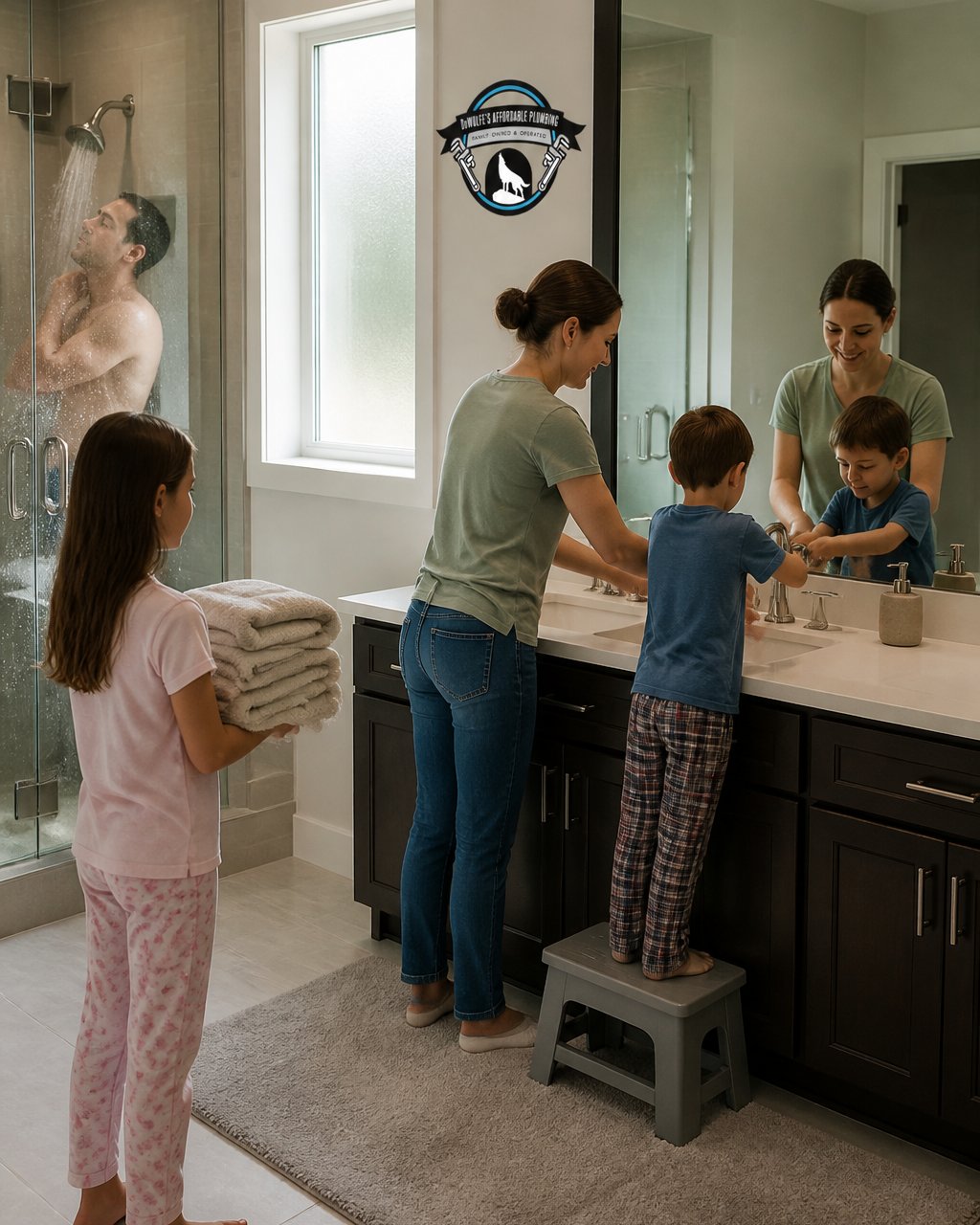
A realistic busy-morning scenario for a family of four: two standard showers (about 4.5 GPM combined), one bathroom faucet (1.2 GPM), and the kitchen faucet (1.8 GPM) totals roughly 7.5 GPM. Add a washing machine and you are near 10 GPM. That is the number to match, not ‘four people.’
Size to your busiest 15 minutes, not your daily average. A unit that covers your peak morning load will handle everything else.
Temperature rise is where cold climates bite
Temperature rise is the difference between incoming groundwater and your target hot-water temperature (usually around 120°F). A unit rated at 9 GPM might hit that number only at a 35°F rise. In colder regions, winter groundwater can run far lower than summer supply, which shrinks usable flow at the same rating.
A common pattern practitioners see: a unit that keeps up in July falls short in January because the incoming water is colder and the same burner output now produces less hot water per minute.
Gas versus electric is an infrastructure decision
Gas tankless units generally deliver higher flow and lower operating cost where natural gas is available, but they require adequate gas-line capacity and proper venting. Electric units skip venting and gas work but draw heavy amperage, so your electrical service must support the load, often a panel upgrade for whole-home electric tankless. Weigh your existing setup before the sticker price.
Lifespan and maintenance
Tankless units generally outlast storage tanks when descaled regularly, and hard water shortens that window by accelerating scale on the heat exchanger. Build descaling into your routine, annually in hard-water areas, to protect the investment.
The Bottom Line on Picking a Family Tankless Heater
Match the unit to your busiest hour, not your average day. Size for simultaneous use, account for cold incoming water, and confirm your gas line or electrical service can support the model before you buy. Get those three right and the rest is straightforward.
At DeWolfe’s Affordable Plumbing, we install and service tankless systems and give you an honest read on whether your home is ready for one. Our team offers on-site estimates, transparent up-front pricing, and a full written warranty on all labor performed. Get started with DeWolfe’s Affordable Plumbing and get continuous hot water sized correctly for your family. Call (972) 632-9935.
Frequently Asked Questions
How big of a tankless water heater do I need for a family of four?
For a family of four, aim for a flow rate that handles two showers plus a sink at once, typically 8 to 10 gallons per minute. Gas models like the Rinnai RU199iN or Rheem RTGH-95DVLN meet this easily. Electric models often need a larger unit or point-of-use heaters for each bathroom. Check your incoming water temperature and desired output to confirm the temperature rise, then match it to the unit’s rating.
Can a tankless water heater supply hot water to multiple showers at once?
Yes, if the unit’s flow rate matches the combined demand. Two standard showerheads use about 4 to 5 gallons per minute total. A gas tankless water heater rated for 8 to 10 gallons per minute handles that comfortably. Electric models may struggle unless sized correctly or supplemented with a point-of-use heater. Always calculate simultaneous use before buying.
Do tankless water heaters need regular maintenance?
Yes. Annual descaling removes mineral buildup, especially in areas with hard water. Flush the heat exchanger with a descaling solution, check the intake filter, and test the pressure relief valve. Skipping maintenance shortens the tankless water heater lifespan and lowers efficiency. Many manufacturers require documented maintenance to keep the warranty valid, so keep records.
Are gas or electric tankless water heaters better for a family?
Gas models generally win for larger families because they deliver higher flow rates and faster recovery for simultaneous use. Electric units suit smaller households, homes without gas lines, or point-of-use setups. Consider installation requirements: gas needs venting and a gas line, while electric may require an electrical service upgrade. Your home’s existing infrastructure often decides the choice.
