
Emergency Plumber Near Me 24 Hours: What to Do First
Table of Contents
- What Constitutes a Plumbing Emergency (And What Can Wait)
- How to Shut Off Your Main Water Valve Before the Emergency Plumber Arrives
- Hiring a Licensed Plumber Checklist: What to Verify Before You Say Yes
- Emergency Plumbing Cost Estimates: Why Transparent Pricing Beats a Low Quote
- When to Call an Emergency Plumber Near Me 24 Hours vs. Wait Until Morning
- How to Prevent Future Plumbing Emergencies
- Frequently Asked Questions
Last Updated: September 24, 2026
What Constitutes a Plumbing Emergency (And What Can Wait)
Water where it shouldn’t be, and no way to stop it: that is the line between an emergency plumber near me 24 hours call and a job that can wait until Tuesday. At DeWolfe’s Affordable Plumbing, we answer this question constantly, and the honest answer saves homeowners money. Not every drip needs a midnight dispatch.
A true emergency meets at least one of three tests:
- Active flooding you cannot stop at a fixture or valve
- No water at all to the home, or no hot water from a failed heater
- A safety risk, such as a suspected gas leak or sewage backing up into living space
Situations That Need a 24-Hour Plumber Now
Call immediately for burst pipes, sewer line backup, water heater failure with leaking or no shut-off, gas odors, or a slab leak you can’t isolate. These cause structural damage, mold, or health hazards within hours. Water damage mitigation gets dramatically harder once water sits overnight.
Problems You Can Schedule for Regular Business Hours
Slow drains, a single dripping faucet, a running toilet, or a water heater that still produces hot water can wait for a scheduled visit. So can most clogged drains that drain slowly rather than not at all. You’ll pay less and get a calmer technician.
Ignoring a slow drain or a faint musty smell under a cabinet often precedes a full sewer line backup. The cheap fix today prevents the expensive emergency next month.
How to Shut Off Your Main Water Valve Before the Emergency Plumber Arrives
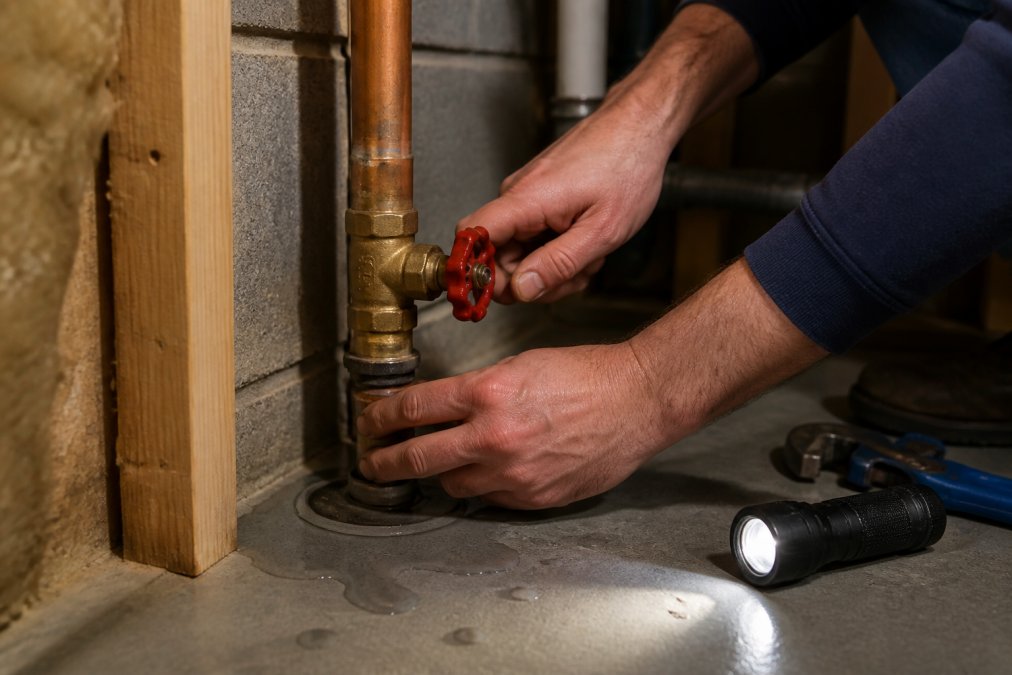
Knowing where your main water shut-off valve lives, and how to turn it, is the single most valuable two minutes of homeowner knowledge you can own. Find it before you need it. While you wait for a technician, every minute of flowing water adds to the repair bill, so the goal is to stop the source, contain what has already escaped, and protect people and property.
Step-by-Step: Kill the Water in Under Two Minutes
- Locate the main shut-off valve. Common spots: near the water meter, in a basement, crawlspace, or utility closet, or outside near the foundation.
- Turn it clockwise until it stops. Gate valves turn many times; ball valves need only a quarter turn.
- Open a low faucet, like a bathtub, to drain remaining pressure and confirm the water has stopped.
- If the valve is stuck or won’t fully close, call for urgent repair rather than forcing it. Forcing a seized gate valve can snap the stem and turn a leak into an open flow.
If you can’t find the valve, shut off the fixture’s local valve, then call. A licensed plumber can walk you through it by phone while a technician is dispatched.
The Stop-the-Damage Checklist: What to Do While You Wait
Shutting the main valve is step one. These are the steps most homeowners never think about until water is already spreading.
- Isolate the fixture, not just the house. Every toilet, sink, and water heater has its own supply valve. Closing the angle stop under a leaking sink stops that line without cutting water to the whole home.
- Kill power to a wet area, carefully. If water is near outlets, appliances, or a ceiling fixture, trip the corresponding breaker before you wade in. Never stand in standing water to reach a panel.
- Shut off the water heater. If the heater itself is leaking, close its cold-water inlet and, for a gas unit, turn the gas valve to the off position. For an electric unit, trip its breaker. A tank that keeps refilling while leaking will keep flooding.
- Stop using drains during a sewage backup. If waste is backing up, do not run water, flush toilets, or run the washing machine or dishwasher. Every gallon you send down the drain adds to what comes back up.
- Contain and document. Towels, buckets, and a wet/dry vacuum limit spread. Photograph the source and the damage before cleanup, most insurers ask for it, and it speeds the claim.
- Open a window for gas odors. If you smell gas, leave the home, don’t flip switches, and call from outside. A plumbing emergency and a gas emergency are handled differently.
Test your main valve twice a year by turning it closed and open again. A valve that hasn’t moved in a decade is the one most likely to fail on the night you actually need it.
Never pour drain cleaner into a fully blocked drain as a first response. If the line is blocked solid, the chemical sits in the pipe, can damage older fittings, and creates a hazard for the technician who arrives to snake it.
Once the water is stopped and the area is safe, you’ve done the part that saves the most money. Everything after that, diagnosis, repair, and drying, is what the emergency plumber is for.
Hiring a Licensed Plumber Checklist: What to Verify Before You Say Yes
Anyone with a wrench can answer a phone. A licensed plumber carries credentials, insurance, and accountability. Before you agree to any work, run this checklist.
- Ask for the license number and verify it with your state licensing board
- Confirm the company carries liability insurance and workers’ compensation
- Get the estimate in writing before work begins
- Ask what the warranty covers and how long it lasts
- Confirm the technician who arrives is the one licensed to do the job
- Ask whether the price can change mid-job, and under what conditions
The best vetting question isn’t about price. Ask: “If you open the wall and find something worse, what happens to my quote?” A transparent company answers before you ask twice. DeWolfe’s Affordable Plumbing provides on-site estimates for residential customers and a full written warranty on all labor performed.
Emergency Plumbing Cost Estimates: Why Transparent Pricing Beats a Low Quote
A low phone quote means nothing if the final bill doubles. Transparent pricing means the number you’re told is the number you pay, barring anything you approve in advance. That’s the difference between a service call and a surprise.
The reason emergency plumbing costs more than a scheduled visit isn’t mystery, it’s structure.
How Emergency Pricing Is Actually Structured
After-hours, weekend, and holiday calls typically carry a surcharge on top of the base rate. That surcharge is normal and legitimate; what isn’t normal is a surcharge that appears for the first time on the final invoice.
What a Fair Up-Front Estimate Should Include
The cheapest quote often becomes the most expensive bill. Providers who lowball the phone estimate frequently add “discovered” charges once the work is underway. A quote that’s dramatically lower than every other one you receive is a signal, not a bargain.
Ask one question that separates honest shops from the rest: “If you open the wall and find something worse, what happens to my quote?” A transparent company answers before you ask twice, and puts the answer in writing.
A written estimate protects you. The number you’re told should be the number you pay, unless you personally approve a change.
When to Call an Emergency Plumber Near Me 24 Hours vs. Wait Until Morning
Call now if water is actively escaping, you smell gas, sewage is backing up, or you have no water at all. Wait until morning for slow drains, single-fixture drips, and non-urgent maintenance. The deciding factor is whether damage compounds while you sleep.
How to Prevent Future Plumbing Emergencies
Most emergencies announce themselves weeks in advance. The trick is knowing what to watch for.
- Schedule an annual plumbing inspection to catch weak valves and corrosion
- Know your main water shut-off and test it twice a year
- Insulate exposed pipes before the first freeze
- Never pour grease down drains; it’s the leading cause of clogged drains
- Replace water heaters approaching the end of their service life, before they fail
Frequently Asked Questions
How much does a plumber charge for an emergency call?
Emergency plumbing cost estimates vary by time of day, the type of repair, and how far the plumber travels. Most companies charge a higher rate for after-hours service, weekends, and holidays. Ask for an up-front, written estimate before any work begins, and confirm whether the after-hours fee is separate from the repair cost. DeWolfe’s Affordable Plumbing provides on-site estimates for residential customers and transparent, up-front pricing, so you know the number before the wrench comes out. Call (972) 632-9935 to discuss your situation.
What is considered a plumbing emergency?
A plumbing emergency is any problem that risks property damage, health, or safety if left overnight. That includes burst pipes, sewer line backups, gas odors, water heater failure with leaking tanks, and an overflowing toilet you cannot stop. A dripping faucet or a slow drain is annoying but usually can wait for a scheduled visit. If water is actively running where it should not, or you smell gas, treat it as an emergency and call a 24-hour plumber immediately.
How do I verify the credentials of a local emergency plumber?
Use a hiring a licensed plumber checklist: ask for the license number and verify it with your state licensing board, confirm the company carries insurance, and check that the technician who arrives is a certified technician, not an unlicensed helper. Ask about the warranty in writing. DeWolfe’s Affordable Plumbing holds Master License #M39597 and is fully licensed and insured, and every job comes with a full written warranty on labor performed.
What steps should I take before an emergency plumber arrives?
Shut off your main water valve to stop the flow, then open the lowest faucet in the house to drain remaining water from the lines. Move furniture and electronics away from the wet area, and use towels or a wet vacuum to limit water damage mitigation. If you smell gas, leave the building and call from outside. Note the time the problem started and any sounds or smells you noticed. That information helps the on-call technician diagnose faster when they arrive.