

Average Cost to Repair a Slab Leak in 2026
Table of Contents
- How Much Does Slab Leak Repair Cost? What Drives the Average
- Slab Leak Symptoms You Should Never Ignore
- Slab Leak Detection Methods: How Plumbers Find the Source
- Slab Leak Repair Methods: Spot Repair, Rerouting, and Repiping
- Slab Leak Repair Time: How Long the Job Takes
- Does Homeowners Insurance Cover Slab Leak Repair?
- Preventative Maintenance: Reducing the Risk of a Slab Leak
- Conclusion: Getting an Honest Answer on Your Slab Leak Repair
- Frequently Asked Questions
Last Updated: October 9, 2026
How Much Does Slab Leak Repair Cost? What Drives the Average
The average cost to repair a slab leak falls in a wide band for most residential jobs. Your number depends on how far the leak has spread, how deep the pipe sits, and whether the line can be reached without breaking concrete. That last factor matters most. A leak under a bathroom floor is a different job than one running beneath a finished living room.
Here is the honest part: anyone quoting you a flat figure over the phone is guessing. Slab leak repair pricing swings widely because the work swings widely.
What the Price Actually Breaks Down Into
A real estimate is a stack of line items, not one number. Expect to see:
- Detection: The cost for acoustic, thermal, and pressure testing combined depends on the specific situation.
- Access: The cost for cutting and removing concrete depends on square footage and whether the slab is post-tensioned.
- Pipe repair or reroute: The cost for a spot fix or to reroute a line overhead depends on the scope of work.
- Concrete patch and finish: The cost for concrete patch and finish depends on the extent of the work, plus flooring replacement if tile or hardwood is disturbed.
- Repiping (whole system): The cost for repiping a whole system depends on the size and complexity of the home.
The Four Factors That Move Your Final Bill
- Access. Can the plumber tunnel in from outside, or does the slab get cut?
- Pipe material. Copper piping wears differently than newer PEX or CPVC lines.
- Leak location. Under a closet is easier than under a kitchen island or a post-tensioned slab.
- Repair type. A spot fix costs far less than a full repipe.
What an Up-Front Estimate Should Include
A real estimate lists the detection method, the access plan, the repair type, and cleanup. Ask for all four in writing. If a quote skips detection, walk away. A plumber who cannot say how the leak will be found cannot honestly say what the repair will cost.
Slab Leak Symptoms You Should Never Ignore
Slab leak symptoms show up long before the damage does. The problem is they look like other household issues, so people wait. Waiting is expensive.
Watch for these:
- A hissing sound under the floor
- Damp spots on carpet or tile that keep returning
- Warm spots on the floor, a sign of a hot-line leak
- Flooring cracks that appear without a cause
- A utility bill that climbs with no change in use
- Mold growth near baseboards
Any one of these deserves a check. Two or more means call someone today.
The Water Meter Test: A Step-by-Step Check
This is the one test every homeowner can run. It takes ten minutes and costs nothing.
- Shut off every faucet, appliance, and irrigation zone.
- Find your water meter and note the reading.
- Wait one hour without using any water.
- Read the meter again.
- If the number moved, you have a leak.
A moving meter with everything off points to a water supply line leak, often under the slab. This test tells you a leak exists. It does not tell you where. That takes professional gear.
DIY vs. Professional Equipment: What You Can and Cannot Check Yourself
You can confirm a leak. You cannot pinpoint one.
A moisture meter from a hardware store reads surface dampness. That helps you narrow a room. It will not find a sub-slab pipe.
Finding the exact spot takes an acoustic listening device, infrared camera, and static pressure test. Those are pro tools. Renting them rarely saves money, because reading them takes training.
Do not break open the slab to “take a look.” Cutting concrete without knowing the leak location damages your foundation and adds thousands to the final bill. Confirm first, cut second.
Slab Leak Detection Methods: How Plumbers Find the Source
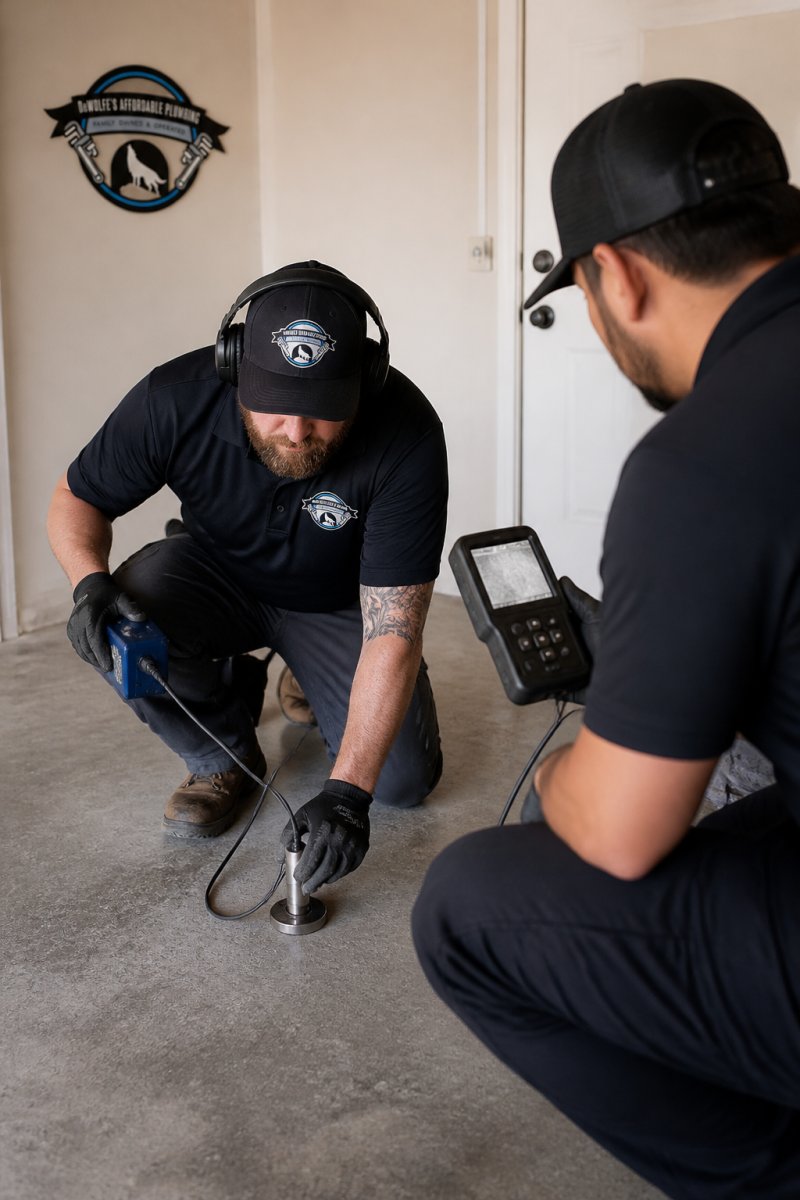
Slab leak detection is the process of locating a hidden pipe leak under a concrete slab without unnecessary demolition. It combines listening tools, thermal imaging, and pressure testing to narrow the search to a small area.
Acoustic Listening, Thermal Imaging, and Pressure Testing
Each method answers a different question:
- Acoustic listening picks up the sound of water escaping a pinhole leak. Best for active leaks.
- Thermal imaging shows warm spots where hot water lines lose heat. Best for hot-line leaks.
- Static pressure test isolates a section of copper piping and confirms whether it holds. Best for confirming a suspected line.
- Hydrostatic testing checks the drainage system separately from the supply lines.
Slab Leak Repair Methods: Spot Repair, Rerouting, and Repiping
Slab leak repair methods fall into three groups, and the right one depends on pipe age and how many leaks you have had.
Spot repair fixes one section. It is the cheapest option and the right call for a single, isolated leak in otherwise sound pipe.
Rerouting abandons the failed line and runs a new one overhead or through the walls. No concrete cutting. Good for older homes where access is brutal.
Repiping replaces the whole plumbing system. It costs the most up front, but if you have had two or more slab leaks, this usually wins long term.
| Method | Best For | Concrete Work | Long-Term Value |
|---|---|---|---|
| Spot repair | One isolated leak | Yes, small area | Short-term fix |
| Rerouting | Hard-to-reach lines | None | Medium |
| Repiping | Repeat leaks, old pipe | None | Highest |
If your home has had two slab leaks in five years, ask about repiping instead of a third spot repair. Repeat pipe corrosion rarely stops at one spot.
Slab Leak Repair Time: How Long the Job Takes
Slab leak repair time runs from a few hours to several days, depending on the method. Detection itself usually takes one to three hours.
- Spot repair: one to two days, including concrete work and cure time
- Rerouting: one to three days
- Repiping: three to five days for most homes
Concrete cure time is the wild card. You cannot walk on a fresh patch right away, and that adds a day or two even when the plumbing is done.
Does Homeowners Insurance Cover Slab Leak Repair?
Sometimes, and the answer hinges on one word: sudden. Most homeowners insurance policies cover water damage from a sudden, accidental leak. They often exclude the pipe repair itself and damage from long-term seepage. A leak you ignored for months reads as neglect to an adjuster.
This is the section most slab leak articles skip entirely. It is also where homeowners lose the most money, because a denied claim turns a covered repair into an out-of-pocket repipe.
How to Document a Slab Leak for an Insurance Claim
Adjusters approve claims with clear evidence and deny claims without it. Build the file before anyone cuts concrete:
- Photograph everything before repairs start. Wide shots of each affected room, then close-ups of damp carpet, warped baseboards, buckled flooring, and any visible mold.
- Keep the failed pipe section. Ask the plumber to cut and save the corroded piece. A pinhole or crack in the metal is physical proof of a sudden failure rather than slow seepage.
- Save all plumbing diagnostics reports. The written detection findings, pressure test results, and thermal images are the technical backbone of the claim.
- Get the detection findings in writing. A one-page summary on company letterhead stating the leak location, method used, and date of discovery carries far more weight than a verbal explanation.
- Track the timeline. Note when you first noticed each symptom and when you called for service. A short gap between discovery and repair supports the “sudden” standard.
- Keep every receipt. Detection fees, repair invoices, flooring replacement, and hotel stays if the home was temporarily uninhabitable are all potentially reimbursable.
What Usually Is and Is Not Covered
- Often covered: sudden water damage to flooring, drywall, baseboards, and personal property; the cost to access the leak in some policies.
- Often excluded: the pipe itself, damage from gradual seepage, mold that developed over time, and any repair tied to deferred maintenance.
Policy language varies by carrier and state, so read the water damage and exclusion sections of your own policy before assuming anything. The Insurance Information Institute’s guide to homeowners claims explains what records to keep and how the claims process works.
Documentation is the whole game. A clear file with photos, the failed pipe, and written detection findings is the difference between a paid claim and a denial.
Preventative Maintenance: Reducing the Risk of a Slab Leak
You cannot inspect under a slab, but you can lower the odds of a failure. Most slab leaks trace back to pipe corrosion, high water pressure, or soil movement.
Try these:
- Keep water pressure under the range your plumber recommends
- Watch for unexplained water usage on your bill each month
- Fix drip detection issues at fixtures before they stress the system
- Schedule a water leak detection check if your home is over 20 years old
- Note any new flooring cracks or damp spots and act fast
Small habits catch small problems while they are still small.
Conclusion: Getting an Honest Answer on Your Slab Leak Repair
Slab leaks reward speed and punish delay. The longer water runs under your foundation, the more structural integrity you lose and the bigger the bill gets.
If you are in Wylie or the surrounding area, DeWolfe’s Affordable Plumbing can help. We are family owned, fully licensed and insured, and we back all labor with a full written warranty. You get on-site estimates, up-front pricing, and 24/7 emergency service when a leak will not wait. Alongside Slab Leak Location and Repair, we handle the related work a slab leak often uncovers, from Waterline Repair or Replacement to the fixtures and lines feeding the affected area.
Call (972) 632-9935 and get a real answer on your slab leak today.
Frequently Asked Questions
What is the average cost to repair a slab leak?
There is no single number, because the cost to repair a slab leak depends on where the pipe runs, how deep it sits, and which repair method fits. A spot repair under an exposed section of slab costs less than rerouting a line through walls or repiping a whole home. Access work, concrete cutting, and finish restoration usually drive the bill more than the pipe itself. DeWolfe’s Affordable Plumbing provides on-site estimates for residential customers so you see the full scope before work begins.
What factors affect the cost of slab leak repair?
The biggest factors are pipe location and depth, slab thickness, and whether the repair is a spot fix, a reroute, or a full repipe. Flooring type matters too: tile and hardwood may require more extensive removal and restoration than carpet. Other cost drivers include how far the leak sits from an accessible edge, whether mold or water damage has spread, and whether the job needs after-hours emergency service. Older homes with copper piping and pinhole leaks often need more exploratory work to isolate the failure point.
Does homeowners insurance cover slab leak repair?
Coverage varies by policy. Most standard homeowners policies cover sudden and accidental water damage, such as ruined flooring or drywall, but often exclude the pipe repair itself, which is treated as wear and tear. Some policies add limited coverage for access and tear-out. Document everything before repairs start: photograph damp spots, keep the failed pipe section, save all invoices, and ask your adjuster in writing what is covered. A written record makes the claim far easier to support.
How long does slab leak repair take?
Slab leak repair time ranges from a few hours to several days. Locating the leak with acoustic listening, thermal imaging, or a static pressure test typically takes one to three hours. A straightforward spot repair through a small opening can finish the same day. Rerouting a line through walls or the attic usually runs one to three days, and a full repipe can stretch to a week or more once concrete, flooring, and finish work are included. Ask for a written timeline with your estimate.