

Water Heater Repair vs Replacement Cost: 2026 Guide
Table of Contents
- Water Heater Repair vs Replacement Cost: The 50% Rule
- Common Water Heater Repairs and What Drives the Bill
- Signs of Water Heater Failure You Should Not Ignore
- Average Water Heater Lifespan and When Replacement Wins
- Hidden Costs: Permits, Disposal, and Warranty Status
- Repair or Replace? A Decision Framework for Homeowners
- Frequently Asked Questions
Last Updated: September 26, 2026
Water Heater Repair vs Replacement Cost: The 50% Rule
The water heater repair vs replacement cost decision usually comes down to one number: 50% of the unit’s price. If a repair bill tops half the cost of a new water heater, replacement generally makes more financial sense.
How the 50% Rule Works
The 50% rule compares your repair quote against the cost of a comparable new water heater, then adds a lifespan check. A repair under half the replacement price on a unit with years left is usually worth doing; one above half on an aging tank is money you won’t recover.
The 50% rule is a starting point, not a verdict. Pair the cost comparison with the unit’s age and the type of failure before you commit.
Common Water Heater Repairs and What Drives the Bill
Most water heater repairs fall into a handful of categories, each with a different cost profile. The final bill is driven less by the part than by three things: labor time, how hard the unit is to reach, and whether the work touches gas or electrical systems that carry code and safety requirements.
Parts-Only vs. Professional Labor
This is the distinction most homeowners miss when comparing quotes. A thermocouple, heating element, or anode rod is inexpensive on its own; the bill is mostly labor, plus a diagnostic or service-call charge many companies apply whether or not you approve the repair.
What Actually Drives the Bill
- Access and clearance. A unit in an open garage or utility closet is faster to work on than one wedged into a crawlspace, attic, or finished cabinet. Tight access adds labor time, and labor time is the bill.
- Drain-down and refill. Any repair that opens the tank or replaces a submerged component requires shutting off the water, draining the unit, and refilling it. That step alone can dominate the visit.
- Gas vs. electric. Gas units involve a pilot light, gas valve, thermocouple, and venting systems, and any gas work typically requires a safety check and, in many jurisdictions, a licensed technician. Electric units rely on heating elements, thermostats, and voltage requirements, which are simpler to service but still require the breaker to be isolated and the element tested.
- Parts availability. Common parts for standard tank sizes are usually stocked on the truck. Less common components, a control board on a specific model, a specialty gas valve, may need ordering, adding a return trip.
- Age of the unit. Older units often have seized fittings and brittle connections, so a job that looks routine on paper takes longer in practice.
Parts That Fail Most Often
The anode rod is the sacrificial component that protects your tank from corrosion; once consumed, the tank itself degrades. A thermocouple or heating element failure is usually straightforward. A pressure relief valve that sticks or leaks is a safety issue needing prompt attention. Sediment buildup reduces efficiency, causes popping noises, and is a common reason homeowners call for service.
| Repair Type | Typical Driver | DIY vs Professional | Long-Term Signal |
|---|---|---|---|
| Thermocouple / pilot light | Part cost, access, gas safety check | Professional recommended for gas | Minor, low concern |
| Heating element | Part cost, voltage check, drain-down | Professional for electric | Minor if tank is sound |
| Anode rod | Part cost, tank access, drain-down | Professional | Preventive, extends life |
| Pressure relief valve | Safety part, code, drain-down | Professional | Safety-critical |
| Sediment flush | Labor time | Professional | Maintenance, not repair |
| Leaking tank | Full replacement | Professional | Replace, not repair |
Ask any contractor to separate the diagnostic charge, the parts, and the labor on the written estimate. A quote that itemizes those three lines is far easier to compare against a replacement bid than a single lump-sum number.
DIY vs. Professional: Where the Savings Actually Are
For a confident homeowner, a sediment flush or anode rod swap on an accessible electric unit is within reach, the parts are inexpensive and the procedure well documented.
Signs of Water Heater Failure You Should Not Ignore
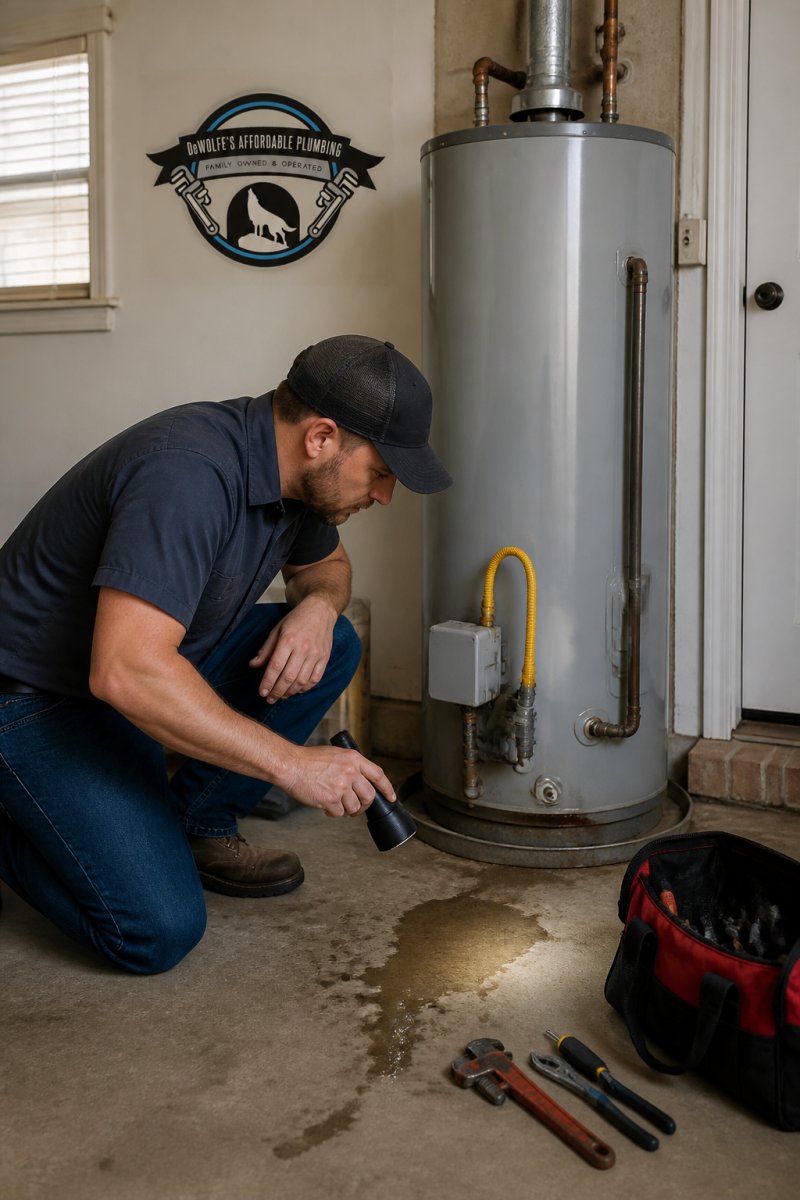
Watch for these warning signs:
- Rust-colored water from hot taps, which points to internal tank corrosion
- Leaking tank or moisture pooling around the base
- Popping or rumbling sounds from sediment buildup
- Short-cycling, where the unit heats in brief bursts
- Inconsistent hot water or a dropping recovery rate
- Pilot light that won’t stay lit on gas units
Average Water Heater Lifespan and When Replacement Wins
The average water heater lifespan is 8 to 12 years for a conventional tank unit and 20-plus for a well-maintained tankless system. Once a tank unit passes 10 years, repair decisions get harder to justify.
Replacement wins when several factors stack up:
- The unit is past its expected unit lifespan
- Repairs are recurring rather than one-time
- Energy efficiency rating has dropped and utility bills are climbing
- The tank shows tank corrosion or a persistent leaking tank
- You’re facing a tankless conversion or a switch from gas to electric
Skipping an annual flush lets sediment buildup harden at the bottom of the tank. That forces the burner or element to work harder, shortens the unit’s life, and can void warranty coverage on some models.
Hidden Costs: Permits, Disposal, and Warranty Status
The sticker price rarely tells the whole story. Permits, plumbing code compliance, disposal fees, and warranty coverage all shift the real water heater repair vs replacement cost comparison, and most guides leave them out.
Warranty Status: The Biggest Swing Factor
Before comparing a repair quote to a replacement quote, find out whether the unit is still under an active manufacturer warranty. This single fact can flip the decision.
- Parts warranty. Most tank water heaters carry a limited parts warranty, commonly several years on the tank, shorter on other components. If a covered part fails, the manufacturer supplies the part, but labor is almost never covered; you still pay the technician.
- Labor warranty. Some manufacturers and some installers offer a separate labor allowance. If yours does, a covered repair can be close to free. If not, you are paying full labor on a part you did not have to buy.
- Pro-rated coverage. Many tank warranties are pro-rated after an initial period, meaning the manufacturer covers a declining share of the replacement as the unit ages. Read the terms rather than assuming “under warranty” means “no cost.”
- Registration and proof of purchase. Warranties frequently require the unit to have been registered at installation and may require the original receipt. Without those, a valid warranty can be denied.
- Installation defects. A warranty can be voided by improper installation, missing expansion tanks, incorrect venting, or work done without a permit.
Permits and Code Compliance
Most jurisdictions require a permit for water heater replacement, and an inspection confirms the install meets current code. Two things follow:
- The permit is a real line item. It is a fee paid to the local authority, separate from the contractor’s labor, and it is easy to forget when comparing bids.
- Unpermitted work creates downstream cost. If a prior replacement was done without a permit, a future sale inspection can surface it, and correcting it later is more expensive than doing it right the first time. It can also void the manufacturer warranty, as noted above.
Disposal and Environmental Fees
Old tanks do not vanish. A replacement almost always includes removing the old unit, and that removal has its own cost:
- Hauling. The old tank has to be disconnected, drained, and carried out. A full tank is heavy, and a unit in a basement or crawlspace takes more labor to remove than one in a garage.
- Recycling. Water heater tanks are largely steel and are recyclable, but recycling is not free, either the contractor absorbs a disposal fee or it appears on your invoice.
- Hazardous components. Sediment, scale, and any residual gas or electrical components may need separate handling depending on local rules.
DIY vs. Professional Labor, Revisited
DIY vs professional labor interacts with every cost above. Gas work, venting systems, and electrical connections carry real safety risk and often require a licensed professional and a permit. DIY savings on a simple part swap evaporate if the job needs a permit, a code-compliant install, or a warranty-valid installation, any of which can cost more later than the labor you saved.
A Simple Way to Compare the Two Numbers
To compare fairly, put both quotes on equal footing:
- Repair side: diagnostic charge + parts + labor + any permit the repair requires.
- Replacement side: unit + labor + permit and inspection + removal and disposal of the old unit, minus any warranty credit you are entitled to.
Once both sides include the same categories, the 50% rule becomes far more reliable, and the gap between repair and replacement is usually narrower, or wider, than the headline numbers suggested.
Repair or Replace? A Decision Framework for Homeowners
Run through these questions in order, and the answer usually surfaces fast.
- Is the unit under 8 years old? If yes, lean repair.
- Is the repair quote under half the price of a new unit? If yes, lean repair.
- Is the tank itself leaking or corroded? If yes, replace.
- Has the unit needed more than one repair in the past two years? If yes, replace.
- Is the unit past 12 years old? If yes, replace.
- Is the unit still under warranty? If yes, get the repair quoted first.
Frequently Asked Questions
What’s the average lifespan of a water heater?
Tank-style water heaters typically last 8 to 12 years, while tankless units can reach 20 years with regular maintenance. Lifespan depends on water quality, usage, and whether the anode rod is replaced on schedule. Once a tank unit passes the 10-year mark, repair bills tend to climb and replacement becomes the more cost-effective path. A licensed plumber can check the anode rod, sediment buildup, and pressure relief valve to estimate how much life is left.
Is it cheaper to repair or replace a water heater?
Repair usually costs less upfront when the unit is under 10 years old and the problem is a single part like a thermocouple, heating element, or pressure relief valve. Replacement makes more financial sense when the tank is corroded, leaking from the base, or when the repair bill exceeds half the cost of a new unit, which is the 50% rule. Weigh the unit’s age, warranty status, and energy efficiency rating before deciding.
Does homeowners insurance cover water heater replacement?
Standard homeowners insurance typically does not cover replacement due to normal wear and tear or old age. It may cover damage caused by a sudden burst tank or leaking supply line, but policies vary. Check your specific policy and deductible before filing a claim. Preventative maintenance, including flushing sediment and testing the pressure relief valve, reduces the chance of a sudden failure that leads to water damage.
How can I tell if my water heater needs to be replaced?
Watch for rust-colored water, rumbling or popping sounds from sediment buildup, moisture or rust around the tank base, and inconsistent hot water. A pilot light that keeps going out or a unit that short-cycles also points to aging components. If your water heater is over 10 years old and shows two or more of these signs, schedule a professional inspection to compare repair and replacement options.
A failing water heater rarely picks a convenient time, and guessing between repair and replacement can cost you more than the job itself. DeWolfe’s Affordable Plumbing offers transparent, up-front pricing, on-site estimates, and 24/7 emergency service, all backed by a full written warranty on labor. Get started with DeWolfe’s Affordable Plumbing and get a clear answer on whether to repair or replace your water heater. Call (972) 632-9935.