
7 Ways Gas Leaks Develop in Pipes and How to Spot Them
Last Updated: November 19, 2026
Quick Summary
Gas leaks develop through seven predictable failure points: corrosion, joint and connection degradation, soil movement, excavation damage, aging materials, flexible connector failure, and concealed or migrated leaks. Most begin as a tiny opening that vibration, moisture, and time widen into a larger leak.
- Corrosion pits steel pipe from inside and attacks coating outside until the wall perforates.
- Threaded joints and unions relax from vibration and thermal cycling, so a seal can weep years later.
- Underground leaks often surface at transitions where pipe meets a foundation or riser.
- Call 811 before any digging so utility lines are marked and excavation damage is avoided.
- Never test a suspected leak with a flame or lighter, which can cause an explosion.
Table of Contents
- How Gas Leaks Develop in Pipes: The 7 Failure Points
- Common Causes of Gas Line Leaks, From Corrosion to Excavation Damage
- Indoor, Underground, and Outdoor Pipe Failures: How Location Changes the Risk
- Signs of a Gas Leak in a House You Should Never Ignore
- How Plumbers Detect Gas Leaks: Pressure Testing, Detectors, and More
- Gas Line Leak Repair: What the Fix Actually Involves
- Schedule a Gas Line Inspection With DeWolfe’s Affordable Plumbing
- Frequently Asked Questions
How Gas Leaks Develop in Pipes: The 7 Failure Points
Gas leaks almost never happen overnight. They build slowly, through seven predictable failure points that appear on gas line calls. Understanding how gas leaks develop in pipes starts with one fact: most leaks begin as a tiny opening, then widen with vibration, moisture, and time. Understanding the cause matters as much as the leak itself. Below, we walk through each failure point and show you how to spot trouble early.
Here are the seven failure points where gas leaks typically begin, and the early signs that point to each one.
| Failure point | How it develops | Early sign |
|---|---|---|
| Corrosion | Moisture and sulfur compounds pit steel from inside; soil attacks coating outside | Faint odor at a fitting or slow rise in consumption |
| Joint and connection degradation | Vibration and thermal cycling relax compressed seals at unions and fittings | Weep at a joint that once passed a pressure test |
| Soil movement and settling | Frost heave and settling concentrate stress where pipe meets foundation or riser | Leak appearing at a transition, not mid-run |
| Excavation and external impact | Digging dents or gouges a line, leaving a weakened wall that fails later | Sudden leak after landscaping or utility work |
| Aging and outdated materials | Bare steel, legacy fittings, and older connectors follow their own degradation paths | Age combined with other stressors raises the odds |
| Flexible connector failure | Corrugated or rubber hose bends, work-hardens, and cracks at kinks | Leak after an appliance is replaced or moved |
| Concealed or migrated leaks | Gas travels along framing, ductwork, or trenches away from the break | Odor in basement or crawlspace with no appliance nearby |
Common Causes of Gas Line Leaks, From Corrosion to Excavation Damage
The most common causes of gas line leaks are corrosion, loose or degraded joints, ground movement, external impact, and aging materials.
Corrosion. Steel and black iron pipe fail from the inside out when moisture and sulfur compounds in the gas combine with oxygen at the pipe wall, and from the outside in when soil moisture, salts, or contact with concrete attack the coating. The result is pitting, small localized craters that eventually perforate the wall.
Joint and connection degradation. Threaded joints, unions, flare fittings, and flexible appliance connectors rely on a seal, pipe dope, thread tape, a gasket, or a brass-to-brass flare, that is compressed at installation. Vibration from appliances, thermal expansion and contraction across seasons, and simple settling gradually relax that compression. A joint that passed a pressure test at installation can develop a weep years later.
Soil movement and settling. Buried pipe is not rigidly supported. Seasonal wetting and drying, frost heave, and gradual ground settling shift the soil around a line. Where a pipe transitions from soil to a foundation wall or a riser, that movement concentrates stress at a single point. Over time a joint can pull apart slightly or the pipe wall can fatigue and crack.
Excavation and external impact. Digging for landscaping, fence posts, pools, or utility work is a leading cause of sudden leaks. A backhoe bucket or a hand shovel can dent, gouge, or crack a line without a full break, leaving a weakened wall that fails later under pressure. Calling 811 before any digging is a common recommendation so utility lines are marked (811 Before You Dig).
Aging and outdated materials. Older installations may use materials and methods that are no longer standard, and every material has its own degradation path rather than a single universal lifespan. Bare steel in damp soil corrodes faster than coated or sleeved pipe. Some legacy fittings and older flexible connectors have known failure patterns.
Cause-to-symptom quick map. A rotten-egg odor concentrated at one appliance usually points to a joint, connector, or valve at that appliance. A odor near the meter or where the line enters the foundation points to a transition or riser. Dead or discolored grass in a stripe across the yard suggests an underground line.
For a deeper look at warning signs and causes, see our guide on common causes of residential gas leaks.
Pipe Material, Age, and Service Life
Failure mechanisms differ by material, which is why no single service life applies to every installation. Black iron and steel resist heat and are common for interior runs, but they rust, internally where moisture collects and externally where coatings fail. Copper resists corrosion in many soils but is vulnerable to certain aggressive soil chemistries and to pinhole pitting, and soldered joints depend on clean, properly fluxed work. Corrugated stainless steel tubing is flexible and resists seismic movement but can be damaged by improper routing, kinking, or contact with sharp edges, and it must be bonded per code. Flexible appliance connectors are the shortest-lived component in many systems because they flex, bend, and work-harden. The practical takeaway: judge a line by material, installation quality, soil and moisture exposure, and history, not by a calendar alone.
Joints, Unions, Valves, and Flexible Connectors
Threaded joints and unions are the most common leak points on any gas line because they depend on a compressed seal rather than a fused wall. A seal that was tight at installation can relax from vibration, thermal cycling, or slight movement. Valves add stem packing and seats that wear with use. Flexible connectors fail at the crimp, at a kink, or where the hose meets the fitting. A common pattern is a leak that appears after a appliance is replaced or moved, when an old connector is reused or a union is re-tightened without a fresh seal and a pressure test.
Indoor, Underground, and Outdoor Pipe Failures: How Location Changes the Risk
Where a pipe sits changes how it fails, how fast gas accumulates, and how soon anyone notices. A location-by-location comparison is the part most guides skip, and it is the part that should shape your suspicion.
Indoor pipe failures. Indoor runs are usually black iron, steel, or corrugated stainless, and they fail most often at joints, unions, valves, and appliance connectors rather than mid-wall. The mechanism is thermal cycling and vibration: an appliance cycles on and off, the pipe expands and contracts, and a threaded joint or flare slowly relaxes. Because indoor spaces are enclosed, even a small leak can accumulate, and the odorant added to natural gas is usually noticeable near the appliance. The risk profile is dominated by ignition sources, pilot lights, switches, and appliances, which is why indoor leaks demand the fastest response.
Underground pipe failures. Buried service lines and yard lines face soil moisture, soil chemistry, frost movement, root intrusion, and external mechanical damage. Steel corrodes externally where coating is damaged; copper can pit in aggressive soils; plastic service lines resist corrosion but can be damaged by digging or by improper installation at fittings. Underground leaks behave differently because gas percolates through soil and can surface far from the break, follow utility trenches or foundation drains, and enter a home at a crack or sump rather than at the leak itself.
Outdoor above-ground pipe failures. Exposed exterior runs and meter sets take sun, rain, freeze-thaw cycles, and physical impact. Ultraviolet exposure degrades some coatings and flexible materials; freeze-thaw can stress fittings; and lawn equipment, ladders, and vehicles cause impact damage. Above-ground outdoor leaks disperse more readily than indoor ones, so odor may be faint, but they are also more accessible for inspection. The meter set and the riser where the service line emerges from the ground are common leak points because they concentrate movement and transition between buried and exposed pipe.
Why location should shape your suspicion. An odor near one appliance points to that appliance’s connection; an odor near the meter or where the line enters the foundation points to a riser or transition; an odor in a basement or crawlspace with no appliance nearby may mean gas has migrated from an underground line. The practical rule: let the location of the odor and the layout of the line guide where a qualified technician tests first, rather than assuming the smell marks the leak.
Signs of a Gas Leak in a House You Should Never Ignore
The signs of a gas leak in a house include a rotten-egg odor, hissing near a line, dead grass over a buried pipe, and higher gas bills. Some leaks give no smell at all, so treat any doubt as real. Watch for:
- A sulfur or rotten-egg smell near appliances or the meter
- Hissing, whistling, or a faint roar at a connection
- Dirt or dust blowing from a joint
- Dead or brown patches in the yard over a line
- Headaches, nausea, or dizziness indoors
Watch out: never test a suspected leak with a flame or a lighter. That mistake can cause an explosion.
How Plumbers Detect Gas Leaks: Pressure Testing, Detectors, and More
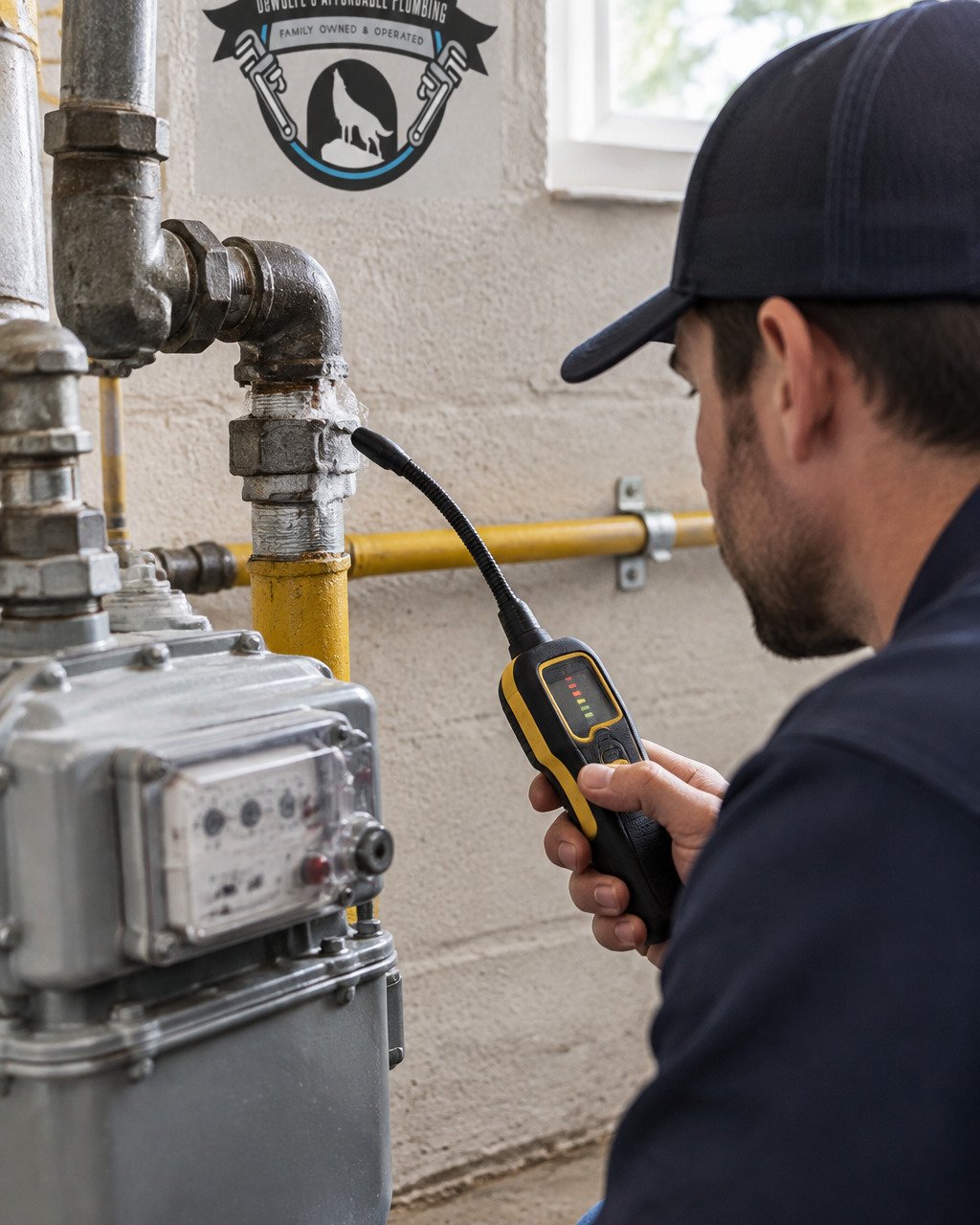
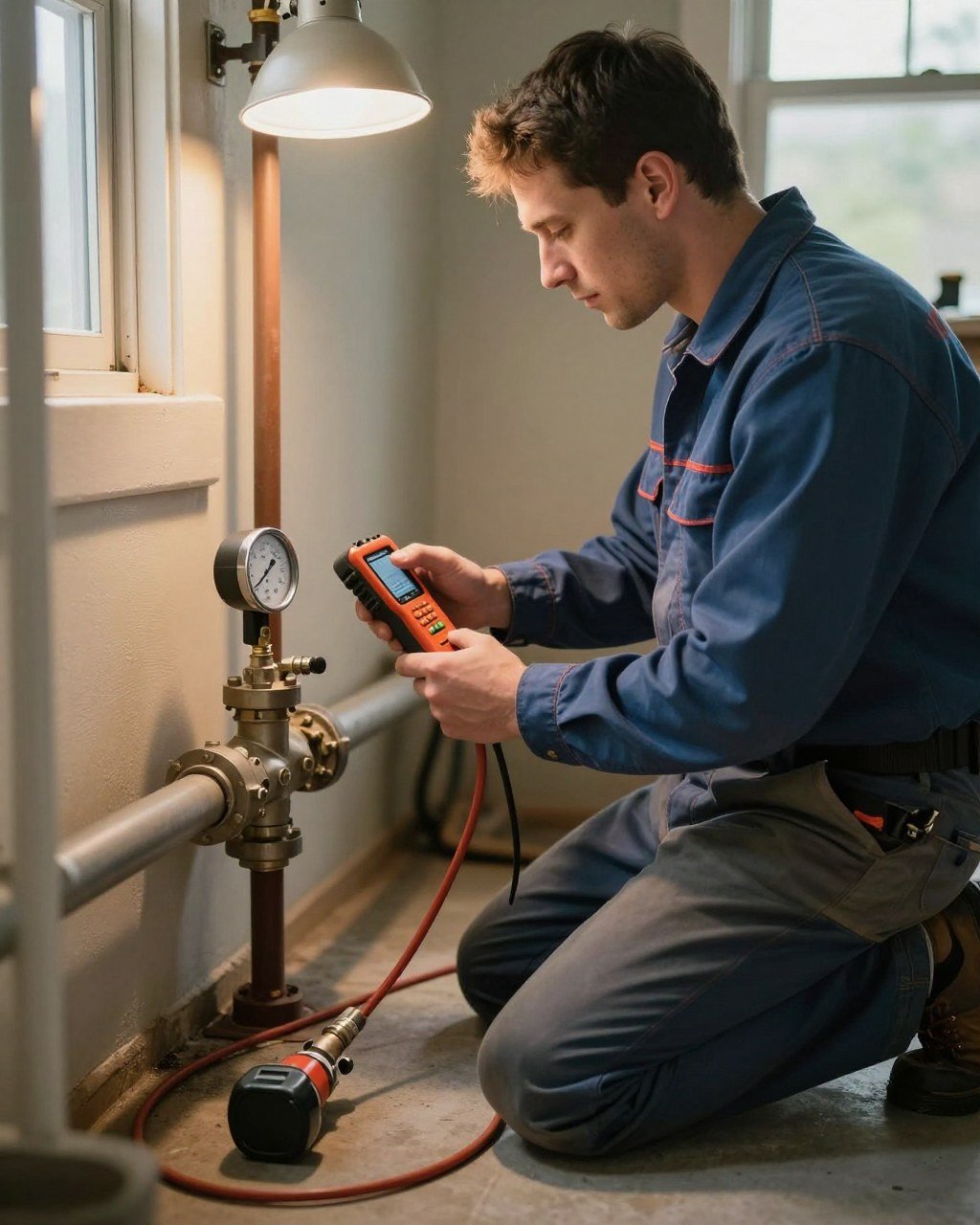
Plumbers commonly detect gas leaks with pressure testing, electronic gas detectors, and manual inspection of joints. Pressure testing isolates a section of line and shows whether it holds. Handheld detectors and combustible gas meters can help pinpoint the exact spot.
Gas Line Leak Repair: What the Fix Actually Involves
Gas line leak repair depends on the cause. A loose union may need only a new seal and a re-tighten. A corroded section gets cut out and replaced with new pipe. A damaged underground line may need excavation and a fresh run. Our work carries a full written warranty on labor.
Schedule a Gas Line Inspection With DeWolfe’s Affordable Plumbing
A gas smell is not a wait-and-see problem. Our licensed team handles gas line repair and install with transparent, up-front pricing and 24/7 emergency service. We are family-owned, fully licensed and insured, and we back our labor with a written warranty. Get started with DeWolfe’s Affordable Plumbing and put a trained eye on your gas line today.
Call our team for a same-day inspection and honest answers about what your line needs. Visit our plumbing services page for contact details and emergency availability.
Frequently Asked Questions
How can I determine if there is a gas leak in a pipe?
Start with your senses: a rotten-egg odor, hissing near a pipe, or dead grass over an underground line are red flags. Bubbles on a soapy solution applied to a joint can confirm a small leak. Never use a flame to test. If you smell gas strongly, leave the building and call your gas utility or a licensed plumber from outside. A professional pressure test is the only reliable way to confirm a concealed leak.
How serious is a minor gas leak?
Even a small leak is serious. Natural gas accumulates in enclosed spaces, and a concentration as low as 5% in air can ignite. Long-term exposure can cause headaches and nausea, and a minor joint leak can grow into a major one as corrosion worsens. Treat any suspected leak as urgent: ventilate, avoid switches and flames, and get a professional inspection.
What causes gas pipes to corrode or crack?
Moisture, soil chemistry, and age are the main drivers. Black iron and steel pipe rust from the inside out, and underground lines face shifting soil and groundwater. Cracks also form at joints, unions, and flexible connectors where vibration and poor installation stress the metal. Outdated materials and faulty installation speed up the process, which is why older homes need periodic inspection.
Can a gas leak develop at a pipe connection?
Yes, connections are one of the most common leak points. Unions, valves, and flexible gas hoses rely on seals that can dry out, loosen, or fail over time. Vibration from appliances and repeated temperature changes work joints loose. A soapy-water test at the connection can reveal small leaks, but a pressure test by a licensed plumber is the definitive check.
