

How Does Hard Water Affect Plumbing Fixtures?
Last Updated: November 18, 2026
Quick Summary
Hard water affects plumbing fixtures by leaving calcium and magnesium deposits behind every time water dries on a surface, and over months these minerals harden into limescale that clogs aerators, restricts flow, and wears down metal parts. The damage is gradual, showing up as weaker shower spray, crusty faucets, and a water heater that works harder each year.
- White chalky crust around faucet spouts and aerator screens is calcium carbonate building in layers.
- Soak aerators and showerheads in undiluted white vinegar for 30 to 60 minutes, then scrub gently.
- Never mix vinegar with chlorine bleach, because the combination creates a toxic gas.
- A water softener prevents new scale but cannot remove scale already hardened inside fixtures or pipes.
- A reading above roughly 7 grains per gallon is commonly treated as hard water.
Table of Contents
- How Hard Water Affects Plumbing Fixtures: The Mineral Buildup Problem
- Hard Water Deposits on Faucets: White Residue, Staining, and Clogged Aerators
- Hard Water Buildup in Showerheads: Restricted Flow and Uneven Sprays
- How to Tell Scale Buildup from Corrosion or a Broken Fixture
- Step-by-Step Fixture Descaling: Cleaning Without Damaging the Finish
- How to Protect Faucets from Hard Water and Slow Future Buildup
- Water Softener System or Spot Treatment? Comparing Your Options
- Book a Plumbing Inspection for Hard Water Damage
- Frequently Asked Questions
How Hard Water Affects Plumbing Fixtures: The Mineral Buildup Problem
Hard water affects plumbing fixtures by leaving calcium and magnesium deposits behind every time water dries on a surface. Those dissolved minerals stay put, and over months they harden into limescale that clogs aerators, restricts flow, and wears down metal parts.
Hard water is water carrying high levels of dissolved calcium and magnesium (Hardness of Water). It is not a health risk, but it is hard on your plumbing.
Here is the part most homeowners miss: the damage is gradual. You will not notice a sudden failure. You will notice a weaker shower spray, a crusty faucet, and a water heater that works harder each year.
Below, we break down where mineral buildup hits first, how to spot it, and how to clean it off without wrecking your fixtures.
Hard Water Deposits on Faucets: White Residue, Staining, and Clogged Aerators
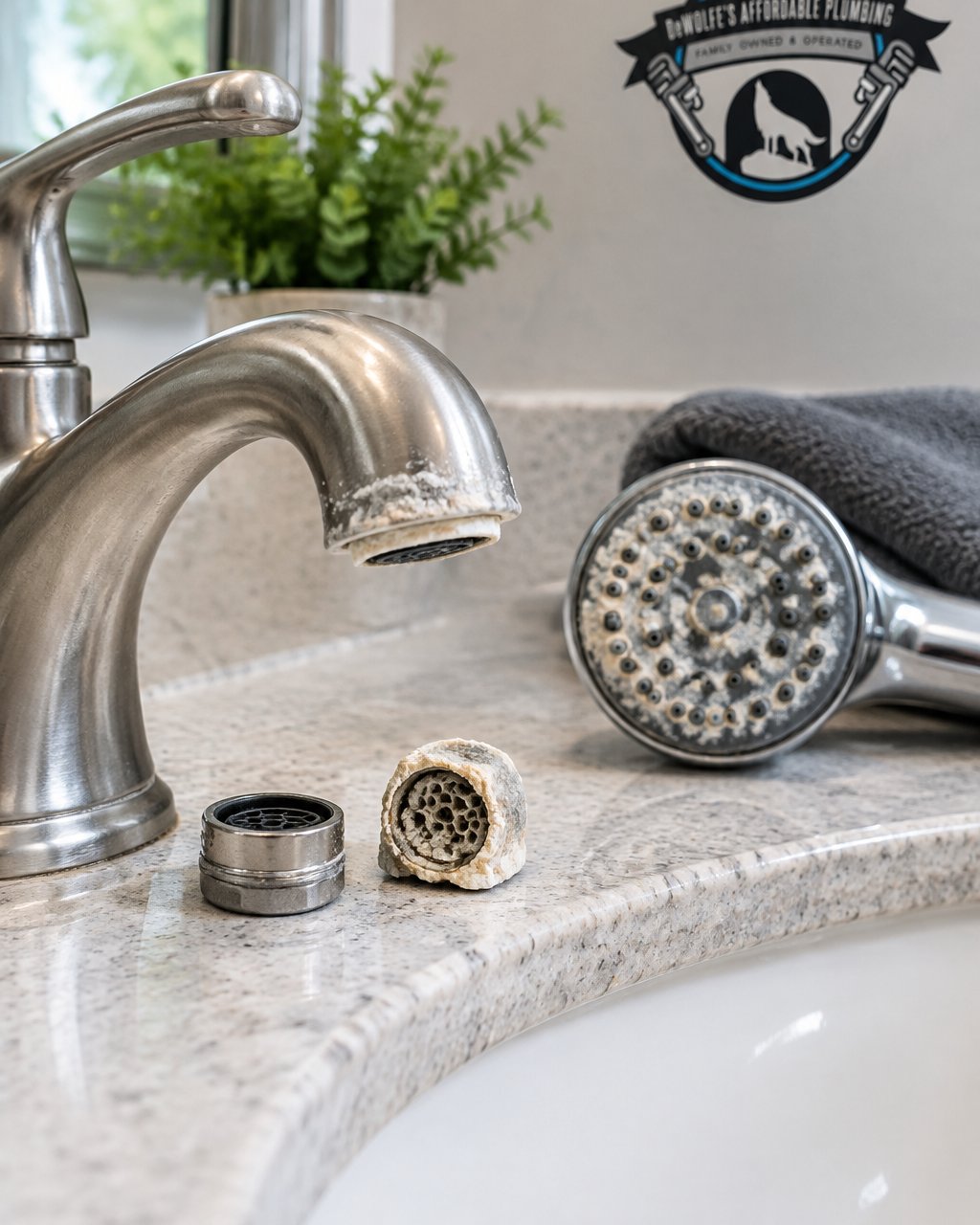
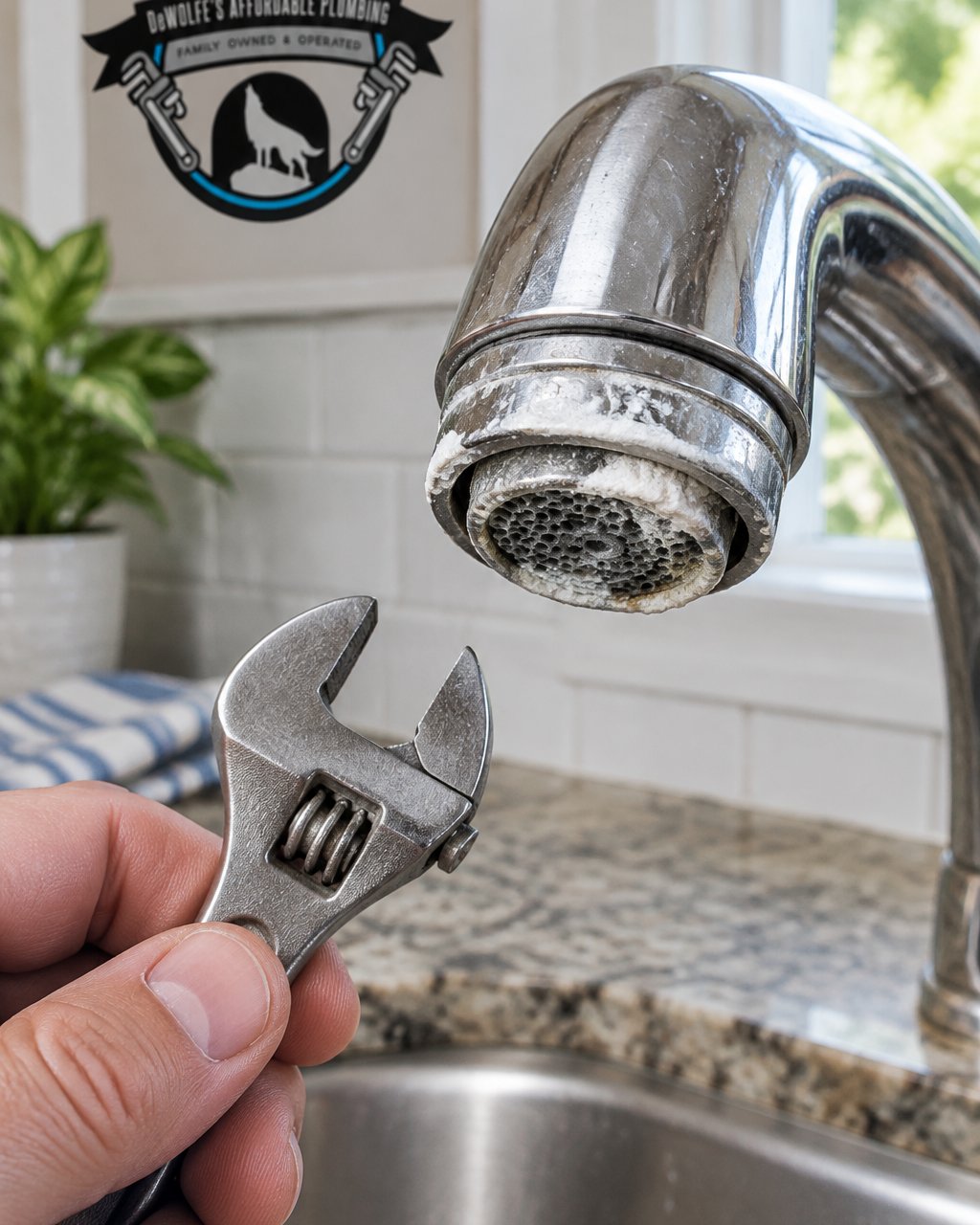
Hard water deposits on faucets show up first as white, chalky crust around the spout and aerator screen. That crust is calcium carbonate, and it builds in layers.
The aerator is the small screened tip on your faucet. It mixes air into the water stream. Mineral scale plugs those tiny screen openings, so the flow turns weak or sprays sideways.
Watch for these early signs:
- White film on the spout and handle base
- Water spots that no longer wipe away
- Reduced flow from one faucet while others run fine
- Chalky buildup on the aerator threads
A common mistake is scrubbing that crust with steel wool. It scratches the finish and gives minerals a rougher surface to grip next time. A soft cloth is a gentler choice than steel wool.
Hard Water Buildup in Showerheads: Restricted Flow and Uneven Sprays
Hard water buildup in showerheads narrows the spray holes until water finds the path of least resistance. That is why an older showerhead often sprays in odd directions instead of straight down.
Scale collects inside the head, not just on the face. Soaking the showerhead in vinegar removes surface crust, but heavy internal buildup may need a replacement head.
What most guides miss is the pressure question. A weak shower is often blamed on low water pressure when the real cause is a scaled-up showerhead and a clogged cartridge behind it. Test it by removing the head and running the water. Strong flow at the pipe means the head is the problem.
How to Tell Scale Buildup from Corrosion or a Broken Fixture
Scale and corrosion look similar at a glance, but they call for different fixes. Scale is a crust that sits on top of the metal. Corrosion is the metal itself breaking down.
Use this checklist to tell them apart:
| Sign | Likely Cause | What It Means |
|---|---|---|
| White, chalky crust | Scale buildup | Clean and descale |
| Blue-green or rust stains | Corrosion | Part may need replacement |
| Weak flow at one fixture | Clogged aerator or cartridge | Clean or swap the part |
| Weak flow at every fixture | Pipe restriction or pressure issue | Call a plumber |
| Pinhole leaks or pitting | Corrosion damage | Inspect the pipe run |
Watch out: if you see rust-colored water or pitting on a valve body, cleaning will not fix it. That is corrosion, and it usually means the part is near the end of its life.
Step-by-Step Fixture Descaling: Cleaning Without Damaging the Finish
Descaling removes mineral buildup safely only when the method matches the fixture material and finish. Vinegar is the default because acetic acid dissolves calcium carbonate, but the same acid that frees a chrome aerator can dull a brushed finish or etch a stone surround. Work fixture by fixture.
Faucet aerators (chrome, stainless, most plastics). Unscrew the aerator by hand; if it is seized, use a padded wrench or a strap wrench so you do not crush the screen housing.
Showerheads. Remove the head from the shower arm and soak the face in a shallow bowl of white vinegar for 30 to 60 minutes. For fixed heads you cannot remove, fill a plastic bag with vinegar, tie it over the head, and leave it for the same window.
Toilet fill and flush valves. Mineral crust on the fill valve seal and flapper seat causes running toilets and weak flushes. Shut off the supply, flush to empty the tank, and wipe the valve parts with a cloth soaked in vinegar.
Cartridge faucets and valve bodies. Scale on the cartridge is usually the cause of a stiff handle or reduced flow at one fixture.
Finish-specific cautions. Chrome and polished stainless tolerate brief vinegar contact. Brushed nickel, oil-rubbed bronze, and living finishes can be stripped or spotted by acids, so test any cleaner on a hidden spot and keep soak times short.
General sequence for any fixture:
- Shut off the water at the fixture stop or supply valve.
- Remove the part if the manufacturer allows it.
- Soak in white vinegar for 30 to 60 minutes, no longer.
- Scrub gently with a soft brush or cloth.
- Rinse thoroughly and reinstall.
- Run the water for a minute and check flow before moving on.
Watch out: mixing vinegar with chlorine bleach creates a toxic gas (the CDC). Never combine them in the same bowl or on the same fixture, and rinse one fully before using the other.
How to Protect Faucets from Hard Water and Slow Future Buildup
The best way to protect faucets from hard water is to stop minerals from settling in the first place. You cannot change your water supply, but you can change how it dries on your fixtures.
Try these habits:
- Wipe down faucets and shower walls after each use
- Soak aerators in vinegar every few months
- Run a descaling cycle on your water heater as the manufacturer directs
- Keep an eye on flow at each fixture so you catch clogs early
These steps buy time. They do not remove the minerals from your water, so buildup will keep returning.
Water Softener System or Spot Treatment? Comparing Your Options
A water softener removes calcium and magnesium from the whole water supply, while spot treatments only clean fixtures after scale forms. That is the core difference, but the practical question is what each option can and cannot prevent.
Ion-exchange softeners. These pass water through a resin bed that swaps calcium and magnesium ions for sodium or potassium ions (the EPA). Because the hardness minerals are removed before the water reaches your fixtures, a softener prevents new scale on aerators, showerheads, valve bodies, and inside the water heater. What it cannot do is remove scale that already hardened inside a fixture or pipe; those parts still need descaling or replacement. Softeners also require salt replenishment and periodic resin cleaning, and they add sodium to the water, which matters for some households on sodium-restricted diets.
Salt-free conditioners. These change the crystal structure of hardness minerals so they are less likely to cling to surfaces, but they do not remove the minerals from the water. Many homeowners find reduced spotting and easier cleaning, but the effect on existing scale and on high-hardness supplies is limited and varies by product. They are not a substitute for a softener when the goal is preventing scale inside a water heater or on fixture internals.
Point-of-use filters. A filter at a single faucet or the shower can reduce sediment and some scale-forming particles, but most carbon and sediment filters are not softeners and will not remove dissolved calcium and magnesium. They help with taste, odor, and particulate matter; they do not solve whole-home hardness.
Replacement parts and descaling. Swapping a clogged aerator or showerhead and soaking fixtures in vinegar treats the symptom. It is the right move when buildup is isolated to one fixture, but it does not stop minerals from returning.
| Option | What It Does | What It Prevents | What It Cannot Do |
|---|---|---|---|
| Ion-exchange softener | Removes calcium and magnesium at the source | New scale on fixtures, valves, and water heater | Remove existing hardened scale; needs salt and maintenance |
| Salt-free conditioner | Alters mineral crystal behavior | Some spotting and surface cling | Remove minerals; reliably protect fixture internals |
| Point-of-use filter | Reduces sediment and some particles | Particulate buildup at one tap | Soften water or stop dissolved-mineral scale |
| Vinegar descaling | Dissolves surface scale | Recurring crust on cleaned parts | Stop new minerals from arriving |
| Replacement parts | Swaps clogged aerators and heads | Flow loss at worn fixtures | Treat the water or protect other fixtures |
How to confirm hardness before choosing. Test strips give a quick reading in grains per gallon or milligrams per liter; most labs and many water utilities report hardness in the same units, and a reading above roughly 7 grains per gallon is commonly treated as hard. Confirm the number before buying a system, because a softener sized for the wrong hardness wastes capacity and salt. If scale keeps returning across every fixture after cleaning, a softener usually makes more sense than repeated descaling. For a closer look at filtration options, see our guide to the best water filtration system for hard water.
Book a Plumbing Inspection for Hard Water Damage
Mineral buildup hides in places you cannot see, like valve bodies, supply lines, and the inside of your water heater. A professional inspection finds that damage before it turns into a leak or a failed fixture.
DeWolfe’s Affordable Plumbing is family owned and operated, and we back all labor with a full written warranty. We offer on-site estimates for residential customers and transparent, up-front pricing. Our licensed and insured team handles water leak detection and water heater service.
Call DeWolfe’s Affordable Plumbing at (972) 632-9935 to get started.
Frequently Asked Questions
How do you get rid of hard water deposits on faucets?
Soak the aerator in equal parts white vinegar and water for 30 to 60 minutes, then scrub the screen with an old toothbrush and rinse. For the faucet body, wrap a vinegar-soaked cloth around the spout for 20 minutes and wipe. Avoid abrasive pads on brushed or polished finishes. If the aerator is crusted shut or the flow stays weak after cleaning, replace the aerator or have a plumber check the cartridge.
Does hard water cause plumbing problems beyond what you can see?
Yes. The same calcium and magnesium that leave white residue on fixtures also coat the inside of pipes, valves, and the water heater. Over time that scale narrows the pipe opening, raises pressure at joints, and can lead to leaks or premature water heater failure. Visible crust on a faucet is usually a sign that buildup is also forming in the parts you cannot see.
How can you tell whether a fixture has hard water buildup?
Look for white or chalky crust around the aerator, showerhead nozzles, and the base of the faucet. Flow that starts strong and fades, uneven shower spray, and water spots that no longer wipe away cleanly are common signs. A simple test is to remove the aerator and inspect the screen: a stiff, crusted screen points to mineral scale rather than a supply problem.
Is a water softener system worth it for protecting fixtures?
A softener removes the calcium and magnesium before they reach your fixtures, so scale stops forming at the source. It is most worthwhile when you see recurring crust on multiple fixtures or when the water heater and appliances are also affected. Spot cleaning handles the symptoms; a softener addresses the cause. Ask a licensed plumber to test your water hardness and confirm a softener fits your home.
