
How Do You Shut Off a Main Water Valve Fast?
Last Updated: November 2, 2026
Quick Summary
To shut off a main water valve fast, turn the handle clockwise until it stops: a quarter turn for a ball valve with a lever, or several full turns for a gate valve with a wheel. Then open the lowest faucet in the house and check that the water meter is still to confirm flow has stopped.
- Shut off electricity to any flooded area at the breaker before touching water.
- A ball valve closes with a quarter turn until the lever sits perpendicular to the pipe.
- A typical gate valve needs five to seven turns clockwise to seat fully.
- Never slip a pipe over the handle for extra leverage, or you may snap the stem.
- Well systems need the valve shut and the pump breaker off to stop flow.
Table of Contents
- The 60-Second Emergency Checklist Before You Touch Anything
- Where Is the Main Water Shutoff Valve in Your House?
- Main Water Shutoff Valve Types and How to Turn Each One
- How to Shut Off a Stuck Water Valve Without Breaking It
- Well Systems and Pressure Tanks: A Different Shutoff Sequence
- How to Confirm the Water Flow Has Actually Stopped
- What to Do After Shutting Off the Water
- When to Call a Licensed Plumber in Wylie
- Frequently Asked Questions
The 60-Second Emergency Checklist Before You Touch Anything
Water is spreading across the floor, and you need to know how to shut off main water valve quickly.
That is the whole job. Most homeowners lose precious minutes because they do not know where the valve is or which way it turns.
So before anything else, run this checklist:
- Shut off the electricity to any flooded area at the breaker
- Move people and pets away from standing water
- Locate the main water valve before water reaches outlets or appliances
The first two steps protect you. Water plus live electricity is a shock hazard, and the Electrical Safety Foundation guidance on water and electricity is blunt about it: never stand in water to flip a breaker you can reach safely from a dry spot.
One more thing. If you see water spraying from a pipe or a bulge in the ceiling, the line may be about to fail.
Where Is the Main Water Shutoff Valve in Your House?
The main water shutoff valve is the single control that stops all water entering your home. It usually sits where the water service line enters the house, often near the water meter or on the wall closest to the street.
Finding it takes seconds if you know your home. It takes a frantic ten minutes if you don’t. Walk your house today, before you need it.
Indoor Locations: Basement, Crawl Space, Garage, and Utility Closet
Most indoor shutoffs hide in one of four places:
- Basement: on the front wall facing the street, often within a few feet of the floor
- Crawl space: near the access hatch, on the pipe coming up through the ground
- Garage: on the wall shared with the house, usually behind stored boxes
Look for a fitting with a handle on the pipe. Clear anything stacked in front of it. A valve you cannot reach in an emergency is a valve you do not have.
Outdoor and Curbside Shutoffs at the Meter Box
Some homes have the shutoff outside, at the meter box near the curb. Lift the lid and you will see the meter and a valve, sometimes set a foot or two down in the ground.
You may need a water meter key from a hardware store to reach a deep curb stop. Keep one taped inside the meter box lid or in the garage.
Main Water Shutoff Valve Types and How to Turn Each One
Two valve types cover nearly every home, and each turns differently. Turning the wrong way, or forcing a valve that is already closed, is how handles snap off. Knowing which one you are looking at before you grab it saves seconds and prevents damage.
Ball Valves: A Quarter Turn Perpendicular to the Pipe
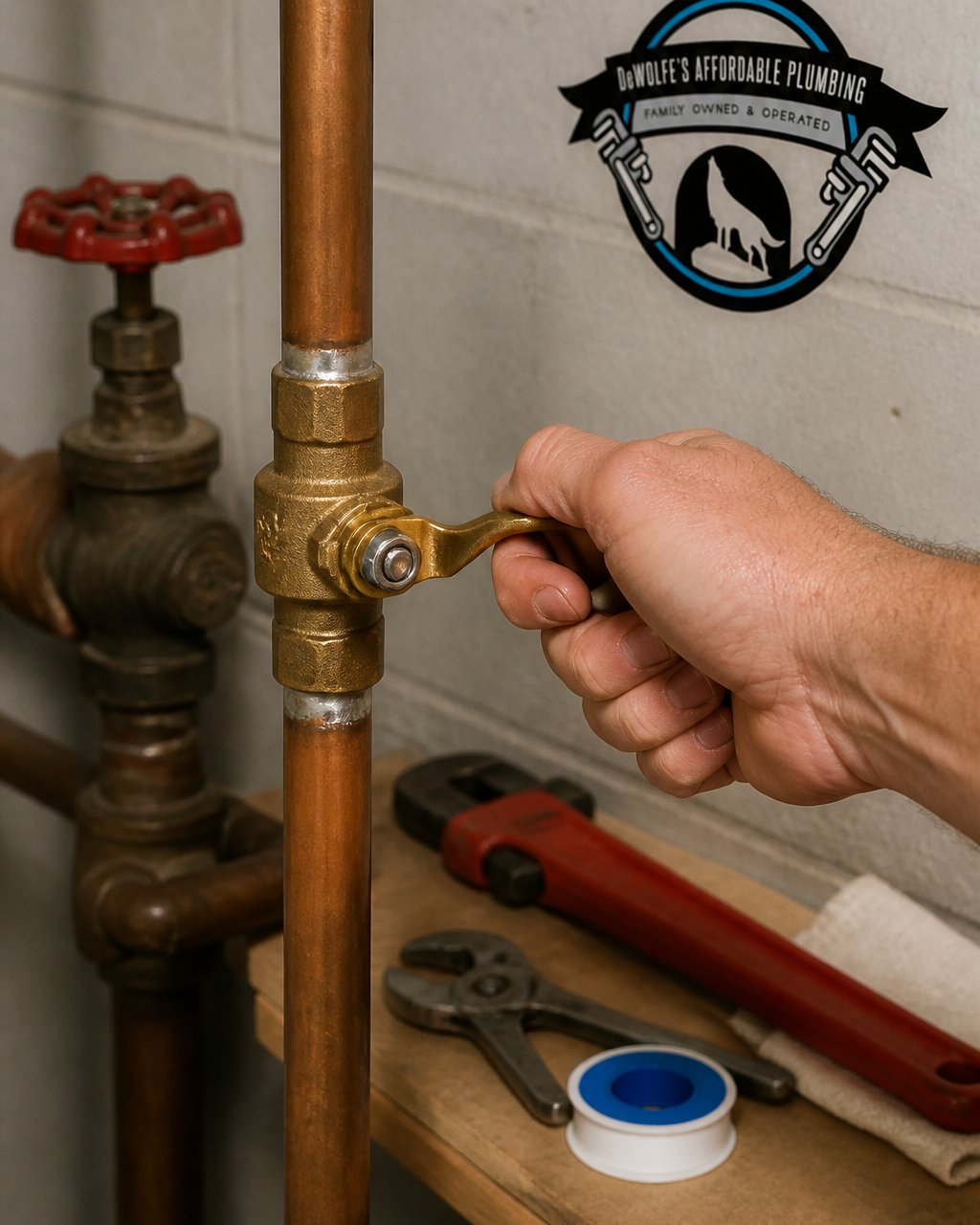
A ball valve has a flat lever handle. Turn it a quarter turn, clockwise, until the handle sits perpendicular to the pipe. That is fully closed.
The handle position tells you the truth at a glance. Parallel to the pipe means open. Perpendicular means shut. No guessing. If the lever will not move a full quarter turn, stop, the valve may already be closed or the ball may be obstructed.
Gate and Wheel Valves: Clockwise Until Seated
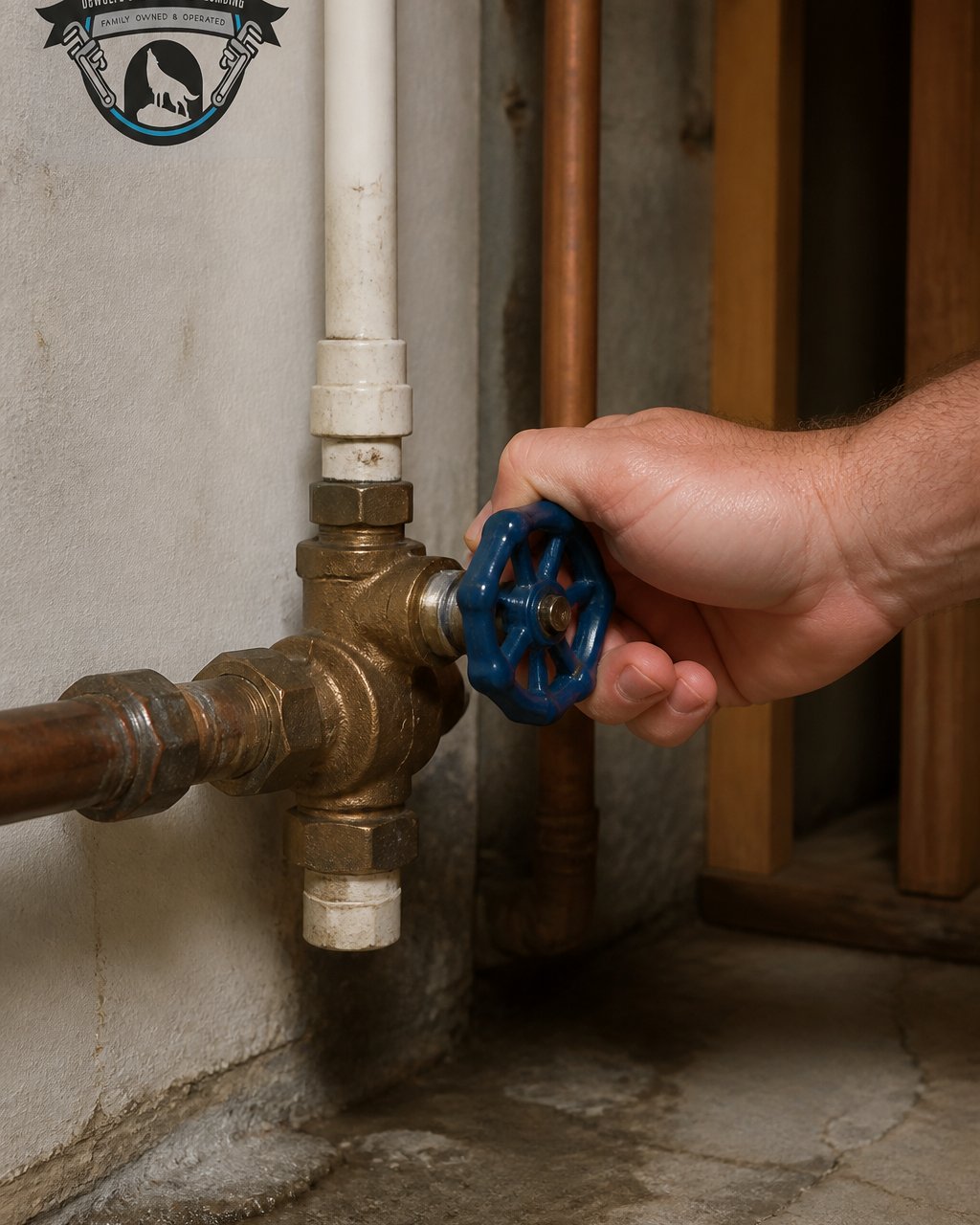
A gate valve has a round wheel. Turn it clockwise, like a jar lid, until it stops. This takes several full turns, not one.
Do not crank past the stopping point. If the wheel keeps spinning without resistance, the stem or gate may be stripped, and the valve is not sealing. That is a repair job, not a DIY one.
Older Valve Styles You May Encounter
Some homes still have a compression or globe valve with a round handle that turns clockwise to close but does not seat as tightly as a ball valve. These are common on older service lines and may need more force to seal. If the handle is a small oval rather than a full wheel, treat it as a multi-turn valve and turn clockwise until resistance stops you, never past that point.
| Valve Type | Handle | Turn Direction | How Far | Closed Looks Like |
|---|---|---|---|---|
| Ball valve | Flat lever | Clockwise | Quarter turn | Handle across the pipe |
| Gate valve | Round wheel | Clockwise | Until it stops | Wheel will not turn further |
| Globe/compression | Oval or round | Clockwise | Until it seats | Handle stops turning |
If you cannot tell which type you have, turn clockwise slowly. Every residential main valve closes clockwise. If it moves freely for more than a quarter turn, it is a multi-turn valve, keep going until it stops.
Match the Valve to Your Home Type
Where the valve sits often hints at its type. Basement and utility-closet shutoffs on newer construction are usually ball valves with levers. Crawl-space and older garage shutoffs are more often gate valves with wheels. Curb-stop valves at the meter box are typically a specialized curb key fitting, not a standard handle, that is why a meter key matters.
If you are unsure, photograph the valve with your phone and show it to a plumber before an emergency forces the issue.
How to Shut Off a Stuck Water Valve Without Breaking It
A stuck valve needs steady pressure, not brute force. Old valves seize from mineral buildup, and a hard yank can shear the stem or crack the packing gland nut.
Try this order:
- Grip the handle firmly and apply slow, even pressure clockwise.
- If it will not budge, spray a penetrating lubricant on the stem and wait a few minutes.
- Tap the valve body lightly with a wrench handle to break the crust.
- Try again with steady pressure, not a jerk.
- If the stem turns but water keeps flowing, stop and call a plumber.
Watch out: never put a pipe over the handle for extra use. That is how homeowners snap a stem inside the wall, turning a quick fix into a water line repair.
Well Systems and Pressure Tanks: A Different Shutoff Sequence
Homes on a private well need two steps, not one. Shut the valve and kill the power, or the pump keeps pushing water into a closed line.
Here is the sequence:
- Find the pressure tank, usually in the basement or a utility room
- Shut the valve on the line leaving the tank toward the house
- Turn off the well pump at its dedicated breaker
If the tank or pump is damaged, the water line itself may need attention. Our water line repair service covers that work.
How to Confirm the Water Flow Has Actually Stopped
Closing the valve is only half the job. You need to confirm the line is actually dead before you start mopping or opening a wall. A valve that looks closed but is not seated will keep feeding the leak, and you will not know until the floor is wet again.
Run this verification in order:
- Open the lowest faucet in the house. A basement sink, laundry tap, or hose bib works best. Let it run for 15 to 30 seconds.
- Watch for the slowdown. Flow should drop to a trickle, then stop. Residual water in the pipes will drain briefly, that is normal and not a sign the valve failed.
- Check the toilet tank. Flush once. If the tank refills at full pressure, supply is still live somewhere.
- Read the water meter. The dial or digital display should be completely still. A moving meter means water is still passing through.
If water keeps running at full pressure after you closed the valve, you closed the wrong valve, or the valve did not seat. Do not assume it is fixed. Re-check the valve position, then move to the stuck-valve steps above.
When to Stop and Escalate
Some situations are not a verification problem, they are a safety problem. Stop and call for help if:
- Water is near outlets, a breaker panel, or an appliance cord. Do not wade in to check a faucet. Shut power at the breaker from a dry spot first, or leave the area and call an electrician.
- The valve will not close and water is actively rising. Call the water utility, they can shut off service at the curb or street, which is often faster than fighting a seized indoor valve.
- You cannot find the main valve at all. A plumber or the utility can locate it. Do not start cutting into walls.
The Surest Check: The Meter
Of all four steps, the meter is the one that cannot lie. A still meter means a closed line, even if a faucet still drips from residual pressure. If you have a digital meter, watch the flow indicator for a full minute before you trust it. If you have an older dial meter, the small triangle or low-flow indicator is the tell, any movement means water is still moving.
Once the meter is still and the lowest faucet has run dry, you can move on to cleanup with confidence.
What to Do After Shutting Off the Water
Now the emergency is paused, not solved. Your next moves depend on why the water is off.
- Soak up standing water and start drying wet surfaces to head off mold (the EPA)
- If the cause was an overflowing toilet, our guide on how to handle an overflowing toilet emergency walks through the cleanup and the fix
- If cold weather is coming, read how to prepare your plumbing for winter before the lines sit drained and idle
Keep the main valve closed until a plumber has made the repair. Turning it back on to “test” a leak usually floods the same floor twice.
When to Call a Licensed Plumber in Wylie
Call a plumber when the valve will not close, when the leak is inside a wall or under the slab, or when you cannot find the shutoff at all.
At DeWolfe’s Affordable Plumbing, we handle residential plumbing across the area, including slab leak location and water line repair.
If water is actively running and you cannot stop it, call us at (972) 632-9935. We offer 24/7 emergency service and same-day or 24-hour response to inquiries.
Frequently Asked Questions
Which way do you turn a main water shutoff valve?
Turn a wheel or gate-style main water valve clockwise, the same direction you turn a jar lid to close it. A lever-handle ball valve needs only a quarter turn, and the handle should end up perpendicular to the pipe. Never force a handle past its stop. If it will not budge, stop and call a licensed plumber rather than risking a broken stem and a full-flow leak.
Should the main water shutoff valve be open all the way?
Yes. Once the repair is finished, open the valve fully rather than leaving it half-closed. A partially open gate valve can chatter and wear out its seat, and a partly open ball valve may not seat cleanly later. Open slowly to avoid a pressure surge, then check the repaired joint for weeping before you walk away.
What should I do if the main water valve is stuck?
Apply steady pressure with the correct tool rather than jerking the handle. A lever valve accepts a gentle nudge; a wheel valve may need a wrench on the stem nut. If the packing gland nut is dripping, tighten it a quarter turn. A valve that will not move at all after reasonable effort is a job for a plumber, since forcing it can snap the stem and leave you with no way to stop the water.
What should I do after shutting off the main water valve?
Open the lowest faucet in the house to drain remaining pressure, then mop up standing water and check for hidden damage. Call a plumber for the repair, and do not restore water until the fix is verified. If the leak sits under a slab, a specialist needs to locate it before you turn anything back on.
A stuck valve or a leak you cannot locate will not fix itself, and every minute of standing water adds to the damage. Get started with DeWolfe’s Affordable Plumbing and get the water stopped, the repair done, and your home dried out before it gets worse.
