
What Happens When a Main Water Line Breaks
Last Updated: November 4, 2026
Quick Summary
A main water line break means water is escaping from the pipe that carries water into your home, causing lost water pressure, discolored water at the tap, and water pooling near your foundation within minutes. Shut off your main valve immediately, then call your water utility and a licensed plumber.
- The public main under the street belongs to the water utility; your service line from the meter to your home is yours.
- If the meter’s low-flow indicator spins with all fixtures off, water is moving on your side of the meter.
- A utility issues a boil-water advisory when main pressure drops low enough that soil or bacteria could enter pipes.
- After repairs, reopen your main valve slowly and run cold water at the lowest faucet to clear trapped air and sediment.
- Call a plumber when the break is on your service line or water won’t clear after flushing.
Table of Contents
- What a Main Water Line Break Actually Does to Your Home
- Signs You Have a Broken Main Water Line
- What to Do If a Water Main Breaks in Your House
- Who Is Responsible for a Water Main Break
- Is the Water Safe? Drinking, Cooking, Bathing, and Appliances
- What to Do After a Water Main Break Is Fixed
- How to Flush Pipes After a Water Main Break
- When to Call a Licensed Plumber in Wylie
- Frequently Asked Questions
What a Main Water Line Break Actually Does to Your Home
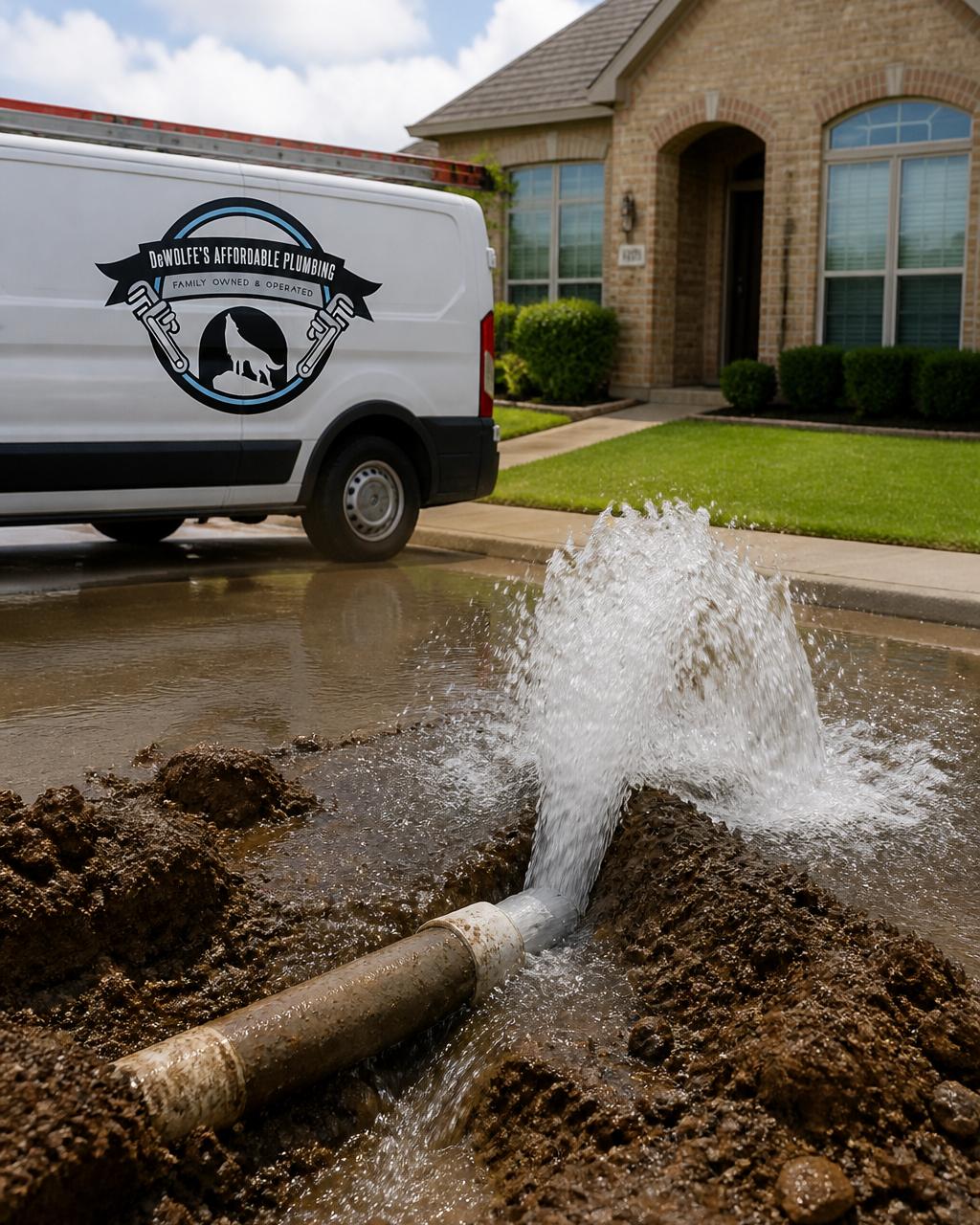
A main water line break means water is escaping from the pipe that carries water into your home, and the damage goes far beyond a wet yard.
Public Main vs. Your Service Line
The pipe that feeds your house comes in two parts. The public main runs under the street and belongs to the water utility. Your water service line branches off at the meter and runs to your home.
That split matters. If you suspect a leak under your slab, our guide on how to detect slab leaks walks through the checks that tell you whether the problem sits on your side of the meter.
Signs You Have a Broken Main Water Line
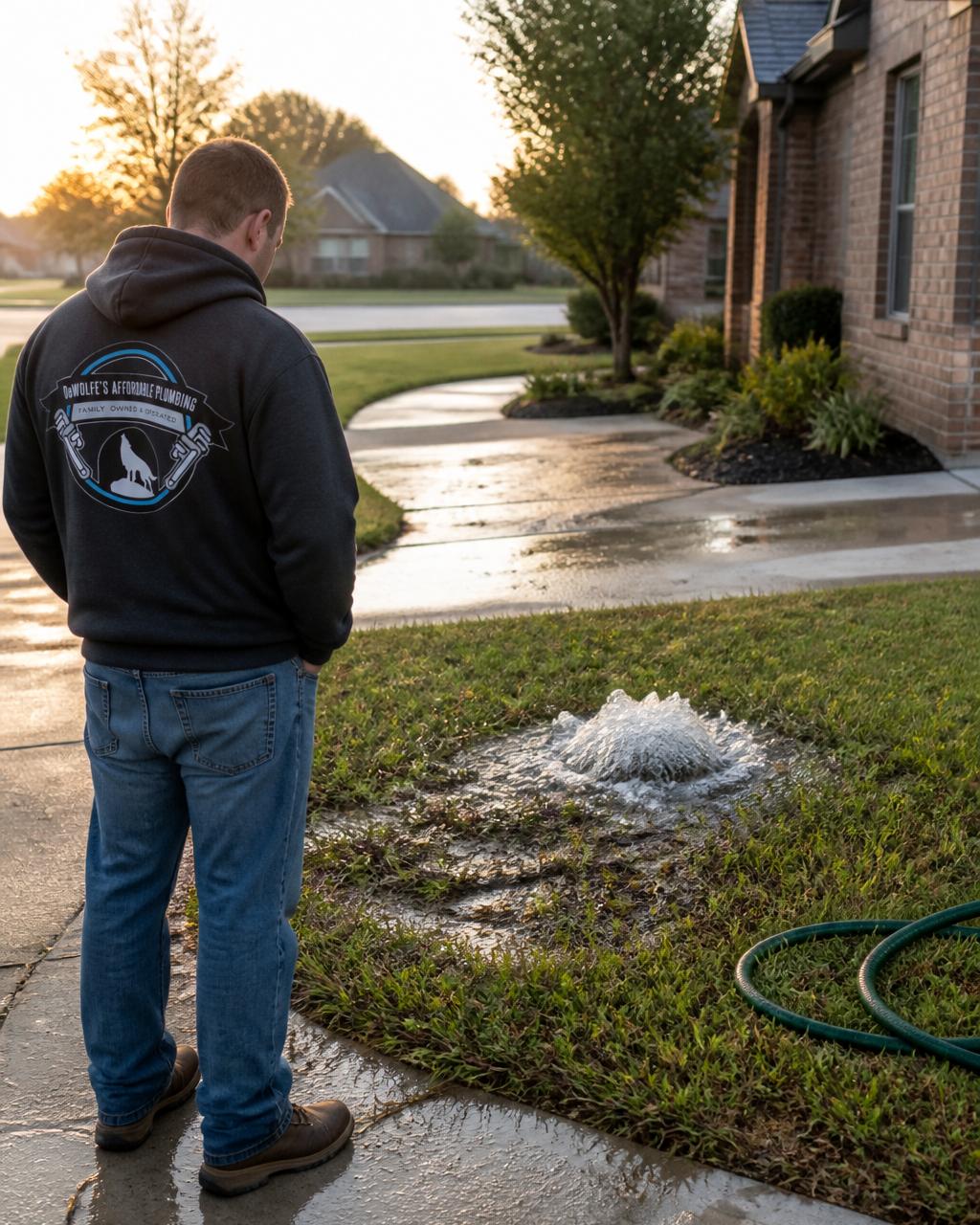
The clearest sign is water pooling in your yard when nothing has run. Other warning signs include:
- A sudden drop in water pressure
- Water bubbling up near the meter or sidewalk
- Cloudy or brown water from cold taps
One symptom alone doesn’t confirm a break. Two or more together usually do. If you want to know whether a pipe is about to give out, our article on 7 warning signs a pipe is about to burst covers the early clues.
What to Do If a Water Main Breaks in Your House
Shut off your water immediately, then call the utility and a licensed plumber. Those two calls come first because every minute of flowing water adds damage.
Your First Hour, Step by Step
- Shut off the main valve. Turn it clockwise until it stops.
- Call your water utility. Report the break and ask whether it’s on the public side.
- Move valuables. Get electronics, rugs, and boxes off wet floors.
- Cut power to flooded areas. Only if it’s safe to reach the breaker.
- Document everything. Photos and video help with insurance later.
- Call a plumber if the leak is on your service line.
If you need help finding the valve fast, our guide on how to shut off a main water valve walks you through it step by step.
Who Is Responsible for a Water Main Break
Responsibility follows the pipe, not the puddle. The water utility owns and maintains the public main under the street, the meter setting, and typically the service line up to the curb stop or property line. The homeowner owns the service line from that point to the house, plus every pipe, valve, and fixture inside the walls. A break on the public side is the utility’s repair; a break on your side is yours.
A Meter-Based Checklist to Locate the Break
Use the water meter as the dividing line. It is the single most reliable landmark most utilities give homeowners.
- Find your meter. It is usually in a concrete box near the curb, sometimes in a basement or utility closet in colder regions. Note which side of the meter faces the street and which faces the house.
- Shut off every fixture inside. Close all faucets, turn off the ice maker, and make sure no appliance is drawing water.
- Watch the meter dial. If the low-flow indicator (often a small triangle or star) is spinning with everything off, water is moving somewhere on your side of the meter.
- Shut the house-side valve. If the meter stops with the house valve closed, the leak is inside or under the slab. If it keeps spinning, the leak is between the meter and the house, your service line.
- Check the curb stop. If water is pooling on the street side of the meter box, the break is likely on the utility’s side. Call the utility before digging.
Watch out: never dig around a meter box or curb stop to “check” a leak yourself. Many utilities treat tampering with the meter setting as a violation, and buried gas or electrical lines often share the same trench.
What Each Party Is Obligated to Do
The utility is generally responsible for responding to reports of main breaks, isolating the affected section, issuing boil-water notices when pressure drops below a threshold that could allow contamination, and restoring service.
On your side, you are responsible for hiring a licensed plumber, obtaining permits if your jurisdiction requires them for service line replacement, and restoring your yard and driveway.
Insurance and Documentation
Homeowner’s policies vary sharply on service line coverage. Many standard policies exclude the pipe itself but may cover resulting water damage to the structure, and some insurers offer an endorsement for exterior service lines.
If the break is on the public main, ask the utility for a claim form and a written incident number. Keep that number with your photos; it is the reference every later conversation will require.
Is the Water Safe? Drinking, Cooking, Bathing, and Appliances
“Is the water safe?” is really three different questions, and the answer depends on which situation you are in. A formal boil-water advisory, a pressure loss without an advisory, and visible contamination each call for different handling. Treat them separately instead of applying one blanket rule.
Scenario 1: A Formal Boil-Water Advisory
A utility issues a boil-water advisory when pressure in the main drops low enough that soil or bacteria could be drawn into the pipes, or when testing confirms contamination (the EPA). The advisory is the strongest signal you will get, and it overrides everything else until the utility lifts it in writing.
- Drinking and cooking: Use bottled water, or bring tap water to a rolling boil for one minute and let it cool (the CDC). Boiling kills bacteria and viruses but does not remove chemical contaminants or sediment; if the advisory cites a chemical issue, boiling is not enough and you should use bottled water only (the CDC).
- Bathing: Adults and older children can shower if they avoid swallowing water and keep the water out of the eyes and mouth. Sponge-bathe infants and anyone with open cuts or a weakened immune system.
- Brushing teeth: Use boiled or bottled water.
Scenario 2: Pressure Loss Without an Advisory
If your pressure dropped or went out but the utility has not issued an advisory, the water is probably safe, but “probably” is doing work. Pressure loss can allow backflow into the lines even when no advisory is issued. Use bottled or boiled water for drinking and cooking until you confirm with the utility that no advisory is in effect, and run cold taps until the water is clear before using it for anything else.
Scenario 3: Visible Contamination (Discolored or Cloudy Water)
Brown, yellow, or cloudy water after a break is usually sediment stirred up by the repair, not necessarily contamination. Run the cold water at the lowest faucet in the house for several minutes. If it clears, the sediment has flushed through. If it stays discolored, or if it smells like sewage or chemicals, stop using it for drinking, cooking, and bathing and call the utility.
A Quick Decision Guide
| Situation | Drinking/Cooking | Bathing | Appliances |
|---|---|---|---|
| Formal boil-water advisory | Boil one minute or bottled | Shower with caution; sponge-bathe vulnerable people | Off until lifted |
| Pressure loss, no advisory | Confirm with utility; use bottled until clear | Usually fine once water runs clear | Run a cold cycle to purge, then resume |
| Visible discoloration | Wait until clear; if persistent, treat as unsafe | Wait until clear | Wait until clear |
| Sewage smell or chemical odor | Do not use; call utility | Do not use | Do not use |
Watch out: a boil-water advisory is not lifted when the water looks clear. It is lifted when the utility’s testing confirms it, and utilities publish that notice through their website, alert systems, or local media. Keep following the utility’s channel until you see the formal lift, not just a neighbor saying the water is fine.
What to Do After a Water Main Break Is Fixed
Once repairs are done, don’t assume everything is back to normal. Check for hidden damage first. Look for:
- Soft spots in drywall or flooring
- Musty smells in the basement
- New cracks in the foundation
Then reopen your main valve slowly. A sudden rush of pressure can stress older pipes. Run cold water at the lowest faucet in the house first to clear trapped air and sediment.
How to Flush Pipes After a Water Main Break
Flush every line in the house before you drink from the tap again. Sediment and air get pushed into the pipes during a break, and they need to clear out.
- Remove aerators from all faucets.
- Open the lowest cold-water faucet and let it run for 5-10 minutes.
- Work upward through the house, one faucet at a time.
- Run the hot water last, starting with the water heater.
- Flush the ice maker and toss the first two batches.
- Reinstall aerators and check for clear water.
If water stays cloudy after flushing, call a plumber. Persistent discoloration can signal a bigger problem inside your plumbing system.
When to Call a Licensed Plumber in Wylie
Call a plumber when the break is on your service line, when water won’t clear after flushing, or when you see damage near the foundation.
At DeWolfe’s Affordable Plumbing, we handle waterline repair and replacement, slab leak location and repair, and emergency service for homeowners across the area. If you want to browse our services before you call, our plumbing blog has more guides like this one.
Frequently Asked Questions
How can you tell if your main water line is broken?
Watch for water pooling or bubbling in the yard between the meter and your foundation, a sudden drop in water pressure at every fixture, discolored or cloudy tap water, and an unexplained spike in your bill. A meter test helps confirm it: shut off every fixture inside, then check whether the meter dial still moves. If it does, water is escaping somewhere on the line.
Who is responsible for a broken water service line?
In most cases the utility owns the public main and the meter, while the homeowner owns the service line running from the meter to the house. That means a break on your side of the meter is usually your repair to arrange and pay for. Call the city first to confirm where their responsibility ends, then contact a licensed plumber for the private section.
Can you flush the toilet or shower during a water main break?
Avoid both until the utility confirms the water is safe. A boil-water notice means the supply may carry bacteria, and flushing a toilet or running a shower pulls that water into your plumbing and spreads it around the bathroom. Use stored water for flushing if you must, and keep showers short and skipped entirely while pressure is low or the notice is active.
What should you do after a water main break is repaired?
Run cold water at every faucet for several minutes to clear sediment, then flush the hot water heater by opening a hot tap until the water runs clear. Remove and rinse aerators, discard ice from the freezer, and run a rinse cycle on the dishwasher and washing machine before using them normally. If the water stays cloudy or smells off, call a plumber to check your service line.
Water damage gets worse by the hour, and a main line break is not a wait-and-see problem. If you’re facing a break on your side of the meter, DeWolfe’s Affordable Plumbing offers 24/7 emergency service, transparent up-front pricing, and a full written warranty on all labor. Call (972) 632-9935 to get a licensed plumber to your door and stop the damage before it spreads.
