
Is Plumbing Work Covered by Warranty?
Table of Contents
- Types of Plumbing Warranties Explained
- Plumbing Labor Warranty Duration and Coverage
- What Voids a Plumbing Warranty
- How to Document Plumbing Repairs for Warranty Claims
- Common Exclusions in Plumbing Warranties
- Filing a Warranty Claim and Dispute Resolution
- Frequently Asked Questions
Last Updated: October 2, 2026
Types of Plumbing Warranties Explained
Understanding whether is plumbing work covered by warranty is essential when deciding if a repair or installation is covered.
Contractor Labor Warranties
A contractor labor warranty covers the work performed by the plumber, not the parts themselves. This workmanship guarantee protects you if something goes wrong with how the job was completed.
This warranty covers installation errors, improper connections, or workmanship defects.
Home Warranty Plans vs. Labor Warranties
A home warranty is a service contract you purchase to cover repair or replacement costs on major home systems, including plumbing. These plans function like insurance and require monthly or annual premiums plus service call fees.
A labor warranty applies to work a specific contractor just completed. A home warranty covers plumbing issues throughout your home, regardless of who installed the system, but typically excludes pre-existing conditions and may not cover emergency calls.
Manufacturer Warranties on Fixtures and Equipment
When a plumber installs new fixtures or equipment like faucets or toilets, the manufacturer usually provides a separate warranty covering defects in the product itself, not the installation. Professional Faucet Repair or Replacement and Toilet Repair or Replacement services ensure proper installation that preserves these manufacturer protections.
Manufacturer warranties vary widely, some cover parts only, others include labor. Always request warranty documentation when new equipment is installed.
Plumbing Labor Warranty Duration and Coverage
A plumbing labor warranty typically lasts one to two years, with one year being most common. The specific duration depends on the contractor and type of work.
Complex work like Slab Leak Location and Repair or sewer line work may carry longer warranties. Simpler jobs like faucet replacement might have shorter periods.
Coverage includes re-doing the work at no cost if it fails due to workmanship issues, answering the question of whether is plumbing work covered by warranty for such defects.
What Voids a Plumbing Warranty
Understanding what voids a plumbing warranty is crucial for protecting your coverage. Many homeowners unknowingly take actions that eliminate their warranty protection, leaving them responsible for repair costs.
Pre-Existing Conditions and Normal Wear
A plumbing warranty does not cover pre-existing conditions. The contractor is only responsible for the work they performed, not for fixing unrelated problems.
Normal wear and tear is excluded. Pipes corrode naturally and fixtures wear out over time, these are expected outcomes of aging systems, not workmanship failures.
Improper Maintenance and DIY Damage
Failure to maintain your plumbing system voids the warranty. If a water heater warranty requires annual inspections and you skip them, the manufacturer may deny a claim.
DIY repairs and modifications void warranties. If you attempt fixes yourself or have unlicensed work done, the warranty becomes invalid.
Using incorrect materials or incompatible parts voids coverage. Replacing sections without consulting a licensed plumber damages system integrity and eliminates warranty protection.
How to Document Plumbing Repairs for Warranty Claims
Proper documentation is essential for warranty claims. Without clear records, disputes arise about what work was performed and what the contractor agreed to cover.
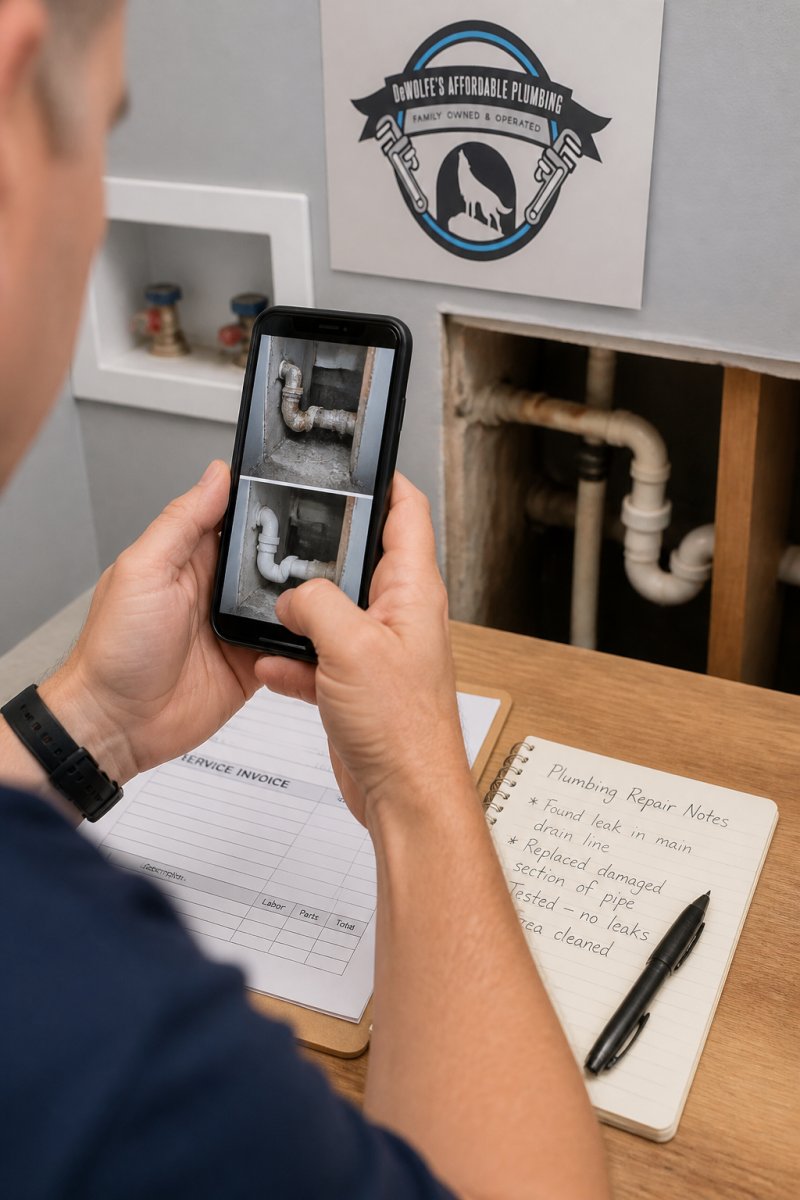
Keep your service invoice, which should include the date of service, work description, parts used, warranty terms, and contractor contact information.
Take photographs of the completed work showing fixtures, pipes, and connections. These photos serve as a baseline if problems develop later.
Digital Documentation Best Practices
Store documentation digitally using cloud storage or email. Include timestamps and location information in your files.
Create a spreadsheet listing all plumbing work, including dates, contractors, descriptions, and warranty expiration dates.
When a problem arises, document it immediately with photos and notes on the date discovered. This evidence strengthens your claim.
Common Exclusions in Plumbing Warranties
Damage from external causes is excluded.
Emergency and after-hours service calls may carry different terms. Always clarify emergency service coverage before you need it.
Plumbing code violations discovered after work is complete can void warranties. The contractor may claim correcting them is a new job.
Damage from frozen pipes, tree root intrusion, or sediment buildup is excluded, these are environmental or maintenance issues, not workmanship failures.
Filing a Warranty Claim and Dispute Resolution
Filing a warranty claim requires a structured approach. How you document and present your claim directly affects whether a contractor will honor it.
Step 1: Notify the Contractor in Writing
Contact the contractor in writing as soon as you discover the problem. Email is best because it creates a timestamped record. Include:
- The date you discovered the problem
- A detailed description of what’s wrong (not just “it leaks” but “water drips from the connection under the sink at a rate of about one drop per minute”)
- The date the original work was completed and your service invoice number
- Photos showing the problem clearly
- A direct reference to the warranty terms from your service agreement
- A specific request: “Please repair this under the labor warranty at no cost, or provide a written explanation of why this is not covered.”
Keep the tone professional and factual. Avoid accusations or emotional language. You’re creating a paper trail that may be reviewed by a licensing board or court later.
Step 2: Document the Contractor’s Response
Most contractors respond within 3-7 business days. They will either:
Agree to repair it. The contractor schedules a time to fix the problem at no charge. Document this repair the same way you documented the original work, photos, invoice, and written confirmation of what was done.
Deny the claim in writing. The contractor explains why they believe the problem is not covered. This is actually helpful because it gives you their reasoning in writing. Review their explanation against your service agreement. Common denials include:
- “This is normal wear and tear, not a workmanship failure.”
- “The problem is caused by lack of maintenance on your part.”
- “This is a pre-existing condition that existed before our work.”
- “You or someone else modified the system after we completed the work.”
If their denial seems unreasonable or contradicts what they promised in writing, you have grounds to escalate.
Ignore your request. If the contractor doesn’t respond within 10 business days, send a follow-up email marked “Second Notice” and state that you will pursue other remedies if you don’t hear from them within 5 business days.
Step 3: Evaluate Your Claim Strength
Before escalating, honestly assess whether you have a strong position:
- Do you have a written warranty agreement? If the contractor never provided written warranty terms, you’re in a weaker position. Verbal promises are harder to prove.
- Does the problem clearly fall within the warranty scope? If the warranty says “labor on installation only” and the problem is a failure of the installed fixture itself, the contractor may be right to deny it.
- Is there evidence the problem is workmanship-related? Photos showing improper installation, connections that don’t match plumbing code, or visible defects strengthen your claim. A problem that could be caused by many factors (age, water quality, external damage) is harder to prove.
- Did you contribute to the problem? If you attempted a DIY fix, modified the system, or failed to maintain it as required, the contractor can use this against you.
Step 4: Escalation Options
If you believe the contractor is wrongfully denying a valid claim, you have several escalation paths:
State Licensing Board Complaint
To file:
- Visit your state’s licensing board website
- Complete a complaint form
- Attach copies of your service agreement, invoice, photos, and all written communication with the contractor
- Explain clearly why you believe the contractor is in violation
The board typically responds within 30-60 days.
Better Business Bureau (BBB) Complaint
File a complaint with the BBB if the contractor is accredited. The BBB will contact the contractor and ask them to respond.
Small Claims Court
If the repair cost is within your state’s small claims limit (typically $5,000-$10,000, depending on the state), you can sue the contractor in small claims court (Understanding small claims court). You do not need a lawyer. Bring:
- Your service agreement and invoice
- Photos of the original work and the current problem
- Copies of all written communication with the contractor
- An estimate from another plumber for the cost to repair the problem
- Any evidence that the problem is workmanship-related
The judge will decide whether the contractor is liable. If you win, the contractor must pay the repair cost plus court filing fees.
Contractor’s Liability Insurance
Many plumbers carry general liability insurance that covers warranty disputes.
Step 5: Prepare for Dispute Resolution
Regardless of which path you choose, your evidence must be clear and compelling:
- Timeline. Show when the work was done, when you discovered the problem, and when you notified the contractor.
- Causation. Demonstrate that the problem is directly caused by how the contractor performed the work, not by external factors or your own actions.
- Cost. Get a written estimate from another licensed plumber for the repair cost. This becomes your damages claim.
- Warranty terms. Highlight the specific language in your service agreement that you believe covers this repair.
If the dispute goes to a licensing board or court, you will likely need to explain your claim to someone (a board investigator, a judge, or an insurance adjuster) who has no prior knowledge of your situation. Your documentation must tell the complete story without you having to be present.
When to Accept a Denial
Not every warranty dispute is winnable. If the contractor’s denial is reasonable and supported by the warranty terms you agreed to, pursuing escalation will waste time and money. For example:
- If the warranty explicitly excludes the type of problem you’re experiencing, you don’t have a case.
- If the problem is clearly caused by age, external damage, or your own modifications, a board or court will likely side with the contractor.
- If the repair cost is very small (under $200), the cost of pursuing a claim may exceed the repair itself.
In these situations, it’s more practical to pay for the repair yourself or get a second opinion from another plumber before deciding to escalate.
Frequently Asked Questions
What is the difference between a contractor labor warranty and a home warranty plan?
A contractor labor warranty covers the workmanship on repairs or installations performed by a licensed plumber, typically 1 to 5 years depending on the service. A home warranty plan is a service contract you purchase separately that covers repair or replacement of major home systems and appliances when they fail due to normal wear and tear. Labor warranties protect you if the plumber’s work fails; home warranties cover system failures regardless of who installed them. Most homeowners benefit from both.
How long does a professional plumbing labor warranty usually last?
Most licensed plumbers offer labor warranties ranging from 1 to 5 years. Standard practice is 1 year for routine repairs like fixture replacement or drain cleaning, and 2 to 5 years for major work such as water heater installation or slab leak repair. Always request a written warranty document that specifies the duration, what work is covered, and the conditions for making a claim. Your service agreement should clearly state the plumbing labor warranty duration before work begins.
Does homeowners insurance cover plumbing repairs?
Standard homeowners insurance typically does not cover plumbing repairs resulting from normal wear and tear or gradual leaks. However, it may cover sudden, accidental damage, such as a pipe burst from freezing or a water line break caused by a tree root. Water damage from a covered loss is usually included, but the plumbing repair itself often is not. Review your policy or contact your agent to confirm what plumbing scenarios your homeowners insurance covers.
What voids a plumbing warranty?
Common warranty voiders include failure to maintain the system properly, DIY repairs or modifications after the original work, damage from improper use, and pre-existing conditions not disclosed before the repair. Ignoring plumbing code compliance or attempting repairs without a licensed professional can also void coverage. Always follow the contractor’s maintenance recommendations and use only licensed professionals for follow-up work to keep your warranty valid.