
Slab Leak Damage to Home Foundations: What Every Homeowner Should Know
Last Updated: November 7, 2026
Quick Summary
Slab leak damage is the deterioration of your foundation and home caused by water escaping from a pressurized pipe beneath your concrete slab. It weakens soil support, warps flooring, and can crack walls from the bottom up, and foundation repairs typically cost far more than the pipe itself.
- Warm spots on the floor and running water sounds with all faucets off are classic late signs.
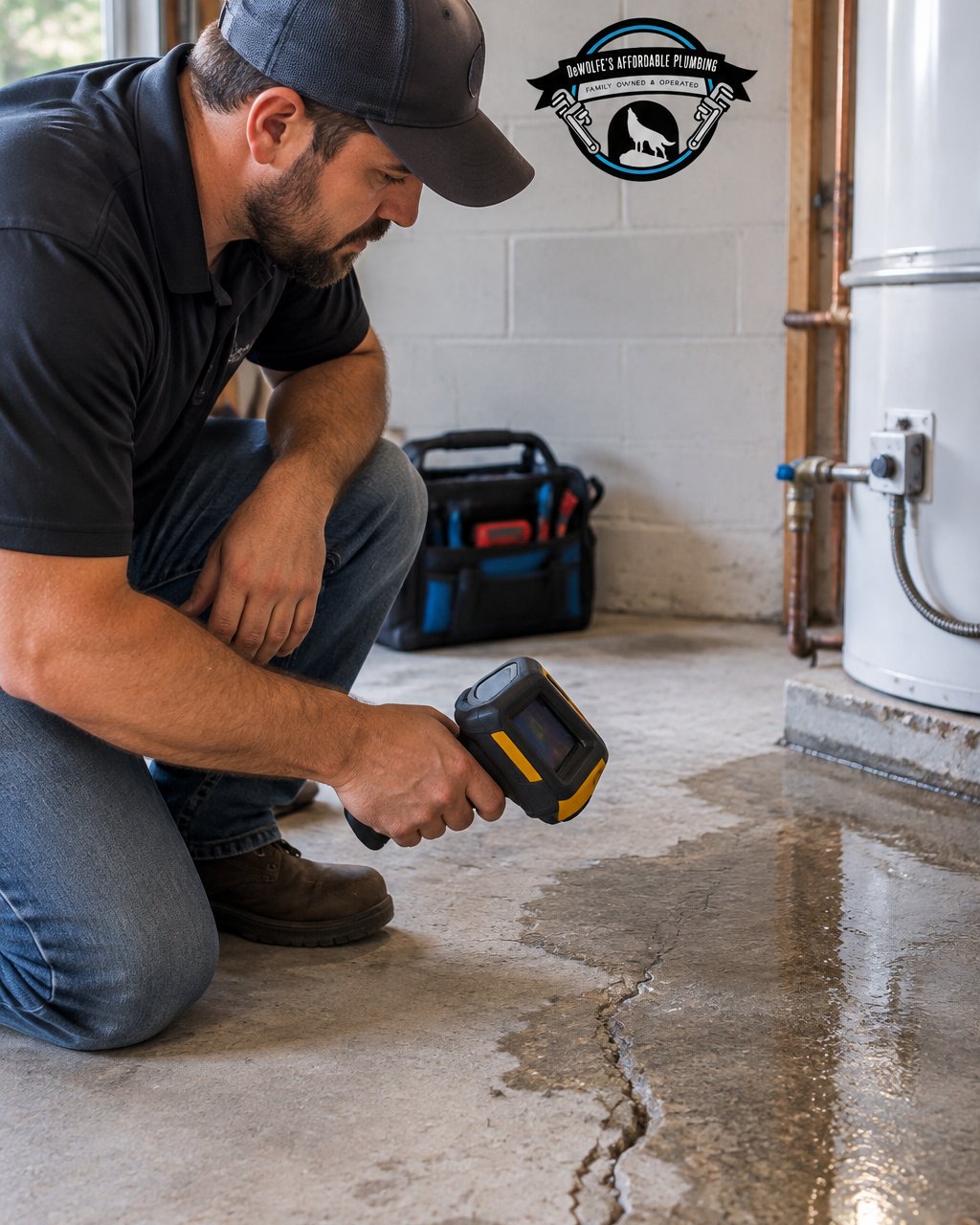
- Acoustic detection and thermal imaging can pinpoint a leak before concrete is cut.
- Pipe rerouting abandons the failing under-slab pipe and runs a new line through walls or attic.
- Ask your insurer in writing whether foundation damage from sudden and accidental discharge is covered.
- Shut off every fixture and watch the water meter to rule out a supply line leak first.
Table of Contents
- How Slab Leak Damage Threatens Your Home’s Foundation
- Slab Leak Symptoms Every Homeowner Should Recognize
- Slab Leak Detection: How Professionals Find Hidden Leaks
- Water Leak Under Concrete Slab Repair: Your Options
- Does Homeowners Insurance Cover Slab Leak Repair?
- Distinguishing Slab Leak Damage from Other Foundation Moisture
- After the Leak Is Repaired: Restoring Your Foundation and Home
- Schedule Your Slab Leak Inspection with DeWolfe’s Affordable Plumbing
- Frequently Asked Questions
How Slab Leak Damage Threatens Your Home’s Foundation
Slab leak damage to home foundations starts quietly. A pinhole leak in a pipe buried under your concrete floor slowly saturates the soil beneath your house. That wet soil expands, shifts, and softens.
A small hidden leak can turn into a structural problem quickly, and foundation repairs are typically far more costly than the pipe itself.
Slab leak damage is the deterioration of your foundation and home caused by water escaping from a pressurized pipe beneath your concrete slab.
The U.S. Environmental Protection Agency’s WaterSense program notes that household leaks waste nearly a trillion gallons of water nationwide each year. Much of that runs unseen under concrete.
Slab Leak Symptoms Every Homeowner Should Recognize
Warm spots on the floor are the classic sign. So is the sound of running water when every faucet is off. But those are late signals.
Early slab leak symptoms are easy to dismiss:
- A water bill that climbs with no change in habits
- Damp or dark patches on carpet near a wall
- Cracks appearing in tile grout lines
- A musty smell with no visible source
- Baseboards that feel soft or pull away from the wall
An unexplained spike in your utility usage deserves attention fast. If your water bill is climbing and you can’t find the cause, our guide on why your water bill is so high walks through the hidden leak checks to run first.
For a deeper look at the warning signs and how to confirm them, see our full breakdown of signs of a slab leak under your foundation.
Slab Leak Detection: How Professionals Find Hidden Leaks
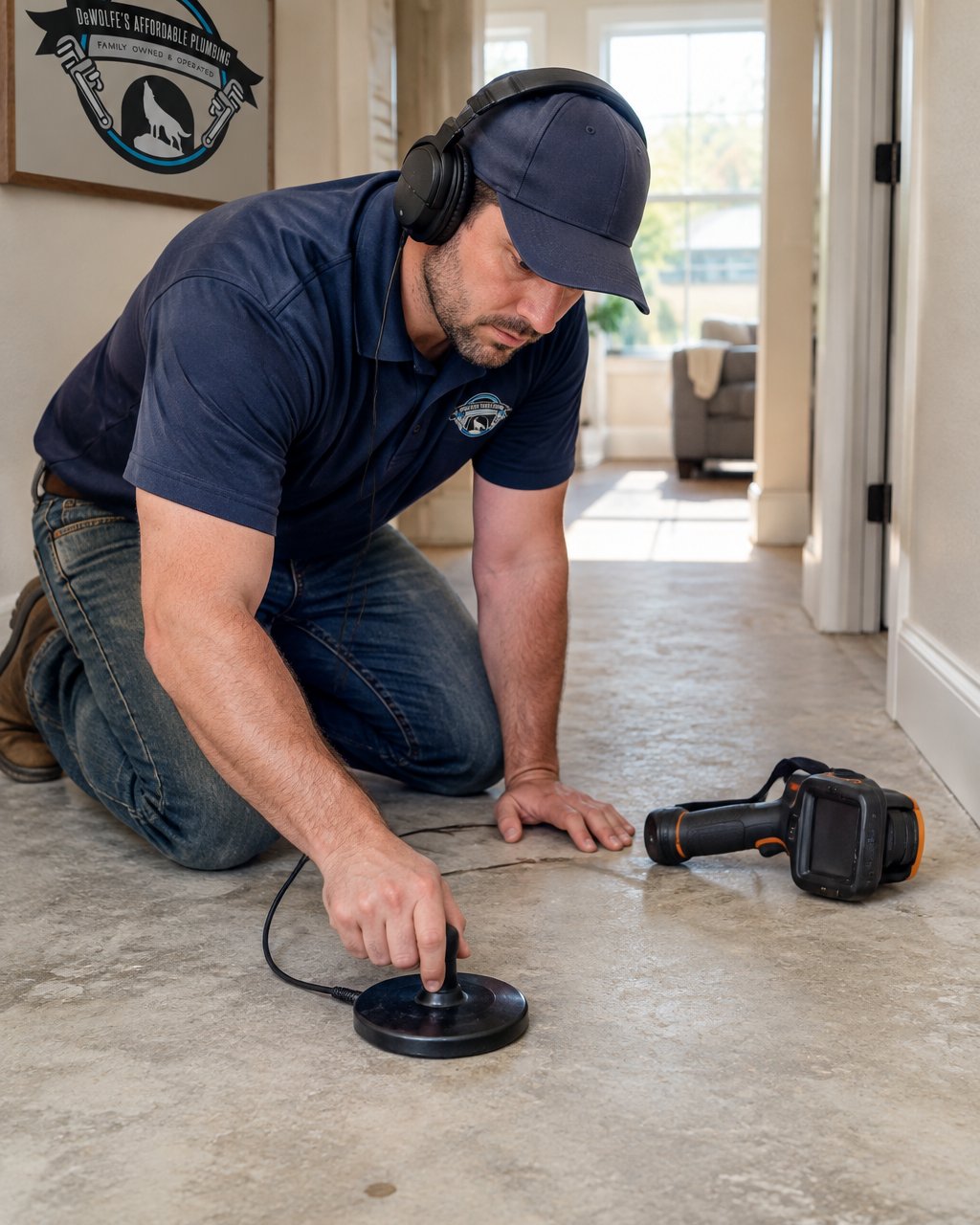
Finding a leak under concrete isn’t guesswork. For a closer look, see our step-by-step guide to how slab leaks are detected. Plumbers use tools that hear, see, and measure what you can’t.
Acoustic and Thermal Tools
Acoustic leak detection uses sensitive microphones to pick up the hiss of pressurized water escaping a cracked pipe. A trained ear can pinpoint the leak within a small area.
Thermal imaging cameras spot temperature differences. A hot water line leak shows as a warm patch on the slab.
Moisture Meters and Pressure Testing
Moisture meters confirm saturation in flooring and walls. Pressure testing isolates the water supply line from the sewer line to confirm which system is leaking.
Together, these tools can narrow the search to a small area before concrete is cut.
Water Leak Under Concrete Slab Repair: Your Options
You have two main paths, and the right one depends on the leak’s location and how much damage it has already caused.
Spot Repair vs. Pipe Rerouting
Spot repair means breaking open the slab at the leak, fixing or replacing that section of pipe, and patching the concrete. It’s direct and often cheaper up front.
Pipe rerouting abandons the failing under-slab pipe and runs a new line through the walls or attic. No concrete is broken. It’s often the smarter choice for older pipes that may leak again elsewhere.
Tunneling and Concrete Access
Some plumbers tunnel under the foundation from outside the home. This reaches the pipe without tearing up your interior floors. It costs more but protects finished spaces.
| Repair Option | How It Works | Best For |
|---|---|---|
| Spot repair | Break slab at leak, fix pipe, patch concrete | Single, isolated leak |
| Pipe rerouting | New line through walls or attic | Older pipes, repeat leaks |
| Tunneling | Access from outside, under the slab | Protecting finished floors |
Before you choose, it helps to understand what slab leak repair typically costs so you can weigh each option.
Does Homeowners Insurance Cover Slab Leak Repair?
Sometimes, and the deciding factor is often the cause of the leak. Many homeowners policies respond to sudden and accidental discharge, though coverage depends on the specific policy.
A slab leak often does not announce itself as sudden, and by the time signs appear, water may have been escaping for some time.
The Four Cost Buckets Adjusters Separate
A slab leak claim is not one number. It is four, and each is treated differently:
| Cost Bucket | What It Covers | Typical Coverage Pattern |
|---|---|---|
| Plumbing repair | Fixing or rerouting the failed pipe | Often excluded or capped; some policies add limited “access” coverage |
| Access and demolition | Breaking and patching the slab, tunneling | Sometimes covered as part of the resulting damage; check policy wording |
| Water mitigation | Drying, dehumidification, mold prevention | More often covered when tied to a sudden event |
| Foundation and interior repair | Cracked slab, settled footings, warped flooring, drywall | Varies widely; foundation coverage is frequently limited or excluded |
The pipe itself is often the smallest line item, while foundation and interior restoration can represent the greater exposure.
The Cause Test in Plain Terms
Ask your insurer three questions before any work begins:
- Does my policy cover sudden and accidental discharge from a plumbing system?
- Is foundation damage resulting from that discharge included, or is it excluded as a separate peril?
- Is there a cap on plumbing access or water mitigation, and what is it?
Get the answers in writing. A phone confirmation is not a coverage determination.
Document Before You Demo
The Insurance Information Institute recommends photographing and videoing everything before repairs start. That means the wet flooring, the warm spot, the water bill history, and the plumber’s detection report. Adjusters weigh contemporaneous evidence heavily, and a detection report that identifies the leak location and cause is often the difference between a paid claim and a denial.
Starting demolition before the insurer inspects may affect the claim, so contact your insurer first and ask whether an adjuster needs to see the site.
What Coverage Does Not Do
Even a paid claim will not restore pre-loss condition beyond policy limits, and it will not fix the underlying reason the pipe failed. If the cause was corrosive soil or aging copper, the next leak is a plumbing question, not an insurance one. Budget for the repair sequence separately from the claim.
Distinguishing Slab Leak Damage from Other Foundation Moisture
Not every damp foundation points to a slab leak, and guessing wrong is expensive in both directions. A homeowner who tears up a slab for a drainage problem wastes money; one who regrades a yard for a supply-line leak wastes time while the soil keeps moving.
The way to separate them is a short diagnostic sequence, run in order, before anyone breaks concrete.
Step 1: Rule Out the Water Supply Line
Shut off every fixture in the house and watch the water meter. If the leak indicator moves with nothing running, there may be a pressurized supply leak somewhere in the system. A plumber can pressure-test the supply side against the sewer side to narrow the source.
A supply leak under the slab often shows a concentrated pattern: one warm spot on a hot line, one damp patch, or a leak that worsens when hot water is used. That concentration is the tell.
Step 2: Rule Out the Sewer Line
A broken sewer line under or near the slab produces moisture too, but the pattern differs. Look for a sewage smell, slow drains throughout the house, or gurgling fixtures. A plumber can run a camera through the sewer line to confirm its condition without any demolition.
Step 3: Rule Out Surface Water and Irrigation
Drainage problems, sprinkler leaks, and heavy rain produce moisture that is broad and edge-biased: dampness along exterior walls, pooling at downspouts, or a wet band that appears after storms and dries between them. Check the irrigation system by running each zone and watching for a constant flow at the meter. Regrading and gutter work solve this category, not slab repair.
Step 4: Rule Out Condensation and HVAC
Condensate lines and air-handler pans can wet a slab edge or a closet floor. This moisture tracks the equipment, not the plumbing, and usually appears during cooling season.
Reading the Pattern
The diagnostic value is in location and timing, not in the presence of moisture alone:
- Concentrated + constant + hot-water-linked → supply-line slab leak
- Smell + slow drains → sewer line
- Edge-biased + weather-linked → drainage or irrigation
- Equipment-adjacent + seasonal → condensation
A professional inspection confirms the pattern before anyone cuts concrete. If the meter test points to a supply leak, our guide on signs of a slab leak under your foundation walks through the confirmation steps, and our team can perform professional water leak detection to settle the question.
Watch out: a damp patch that appears only after rain is not evidence of a slab leak, and treating it as one can lead to unnecessary demolition. Run the meter test first; it costs nothing and eliminates the most expensive possibility.
After the Leak Is Repaired: Restoring Your Foundation and Home
Fixing the pipe is step one. The soil and foundation need attention too.
Here’s the response plan we recommend:
- Confirm the leak is fully stopped with a pressure test.
- Dry the affected area to prevent mold growth.
- Assess the soil and foundation for settlement or shifting.
- Repair flooring, drywall, and cracks.
- Monitor for new cracks over the next few months.
Water mitigation matters more than most people think. Trapped moisture under flooring can feed mold, so drying the space promptly is generally advisable (the EPA).
If the foundation shifted, you may need a structural assessment. Catching settlement early keeps small fixes small.
Schedule Your Slab Leak Inspection with DeWolfe’s Affordable Plumbing
A hidden leak under your slab won’t fix itself. Every week you wait, the water keeps moving soil and stressing your foundation.
DeWolfe’s Affordable Plumbing is family owned and operated, fully licensed and insured, and backs all labor with a full written warranty.
If you suspect a leak, don’t guess. Our team can perform professional water leak detection and tell you exactly what you’re dealing with before any concrete gets cut.
Call (972) 632-9935 to schedule your inspection and protect your foundation.
A small hidden leak today can become a foundation repair tomorrow.
Frequently Asked Questions
Will homeowners insurance cover a slab leak?
Most standard homeowners insurance policies cover sudden and accidental water damage from a slab leak, such as ruined flooring or drywall, but they typically exclude the cost of repairing the pipe itself. Coverage depends on your specific policy and whether the damage is considered a covered peril. Review your policy or contact your insurer to confirm what is included before filing a claim.
How common are slab leaks in homes?
Slab leaks are relatively common in homes with copper or galvanized pipes, especially as plumbing ages. In North Texas, shifting soil and water pressure fluctuations can accelerate pipe wear. While exact statistics vary, many plumbers report that slab leaks become more frequent in homes over 15 to 20 years old. Early detection helps prevent serious foundation damage.
Can a slab leak damage a home’s foundation?
Yes, a slab leak can seriously damage a home’s foundation. Continuous water under the slab can erode or saturate the soil, leading to foundation settlement, shifting, and cracking. Over time, this can cause structural damage to walls, floors, and the overall stability of the home. Prompt repair is essential to prevent further damage.
What should you do if you suspect a leak under a concrete slab?
If you suspect a slab leak, turn off your water supply and call a licensed plumber for a professional inspection. Avoid walking on wet areas or attempting DIY repairs. A plumber can use slab leak detection tools to confirm the leak and recommend repair options. Early action reduces the risk of foundation damage and costly repairs.
